
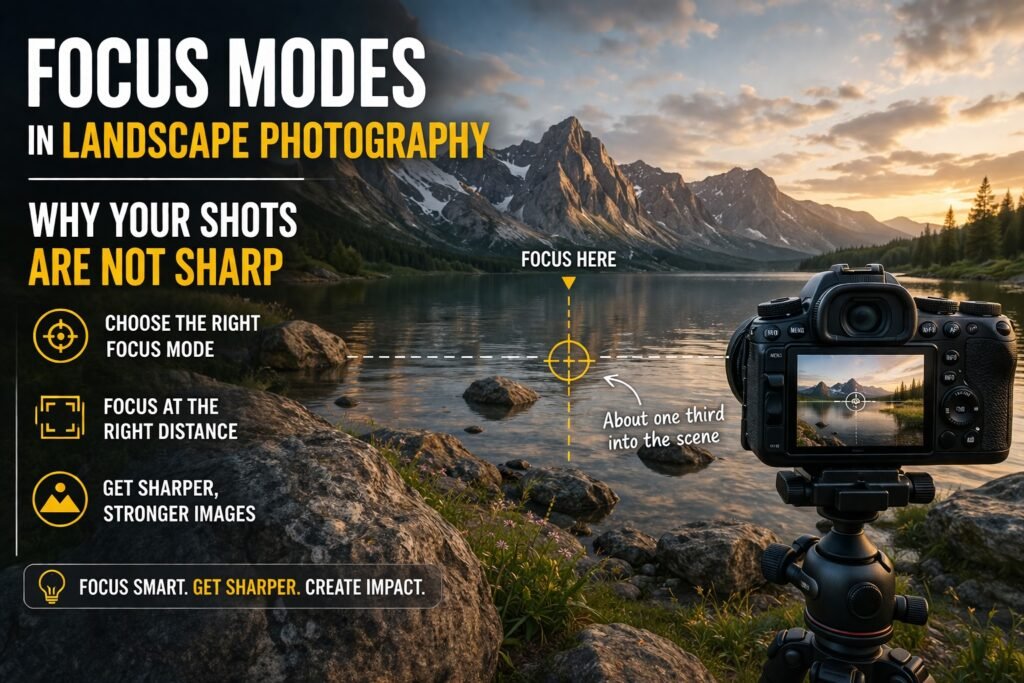
Your photo looks sharp… until you zoom in.
That’s when the truth shows up. The foreground is soft, the detail falls apart, and the whole image feels weaker than you expected. I see this all the time during outings. Good light, strong composition, but something just doesn’t hold together.
Most people blame the lens.
From my experience, it’s almost never the lens. It’s how you focus.
Why sharpness feels inconsistent
In landscape photography, sharpness is not about one point. It’s about how the entire scene holds together.
You might have a beautiful foreground, a clean midground, and a strong background. But your camera can only focus on one distance at a time. If that choice is off, part of your image will quietly fall apart.
That’s why two people can stand side by side, shoot the same scene, and come back with very different results.
The focus mode that works most of the time
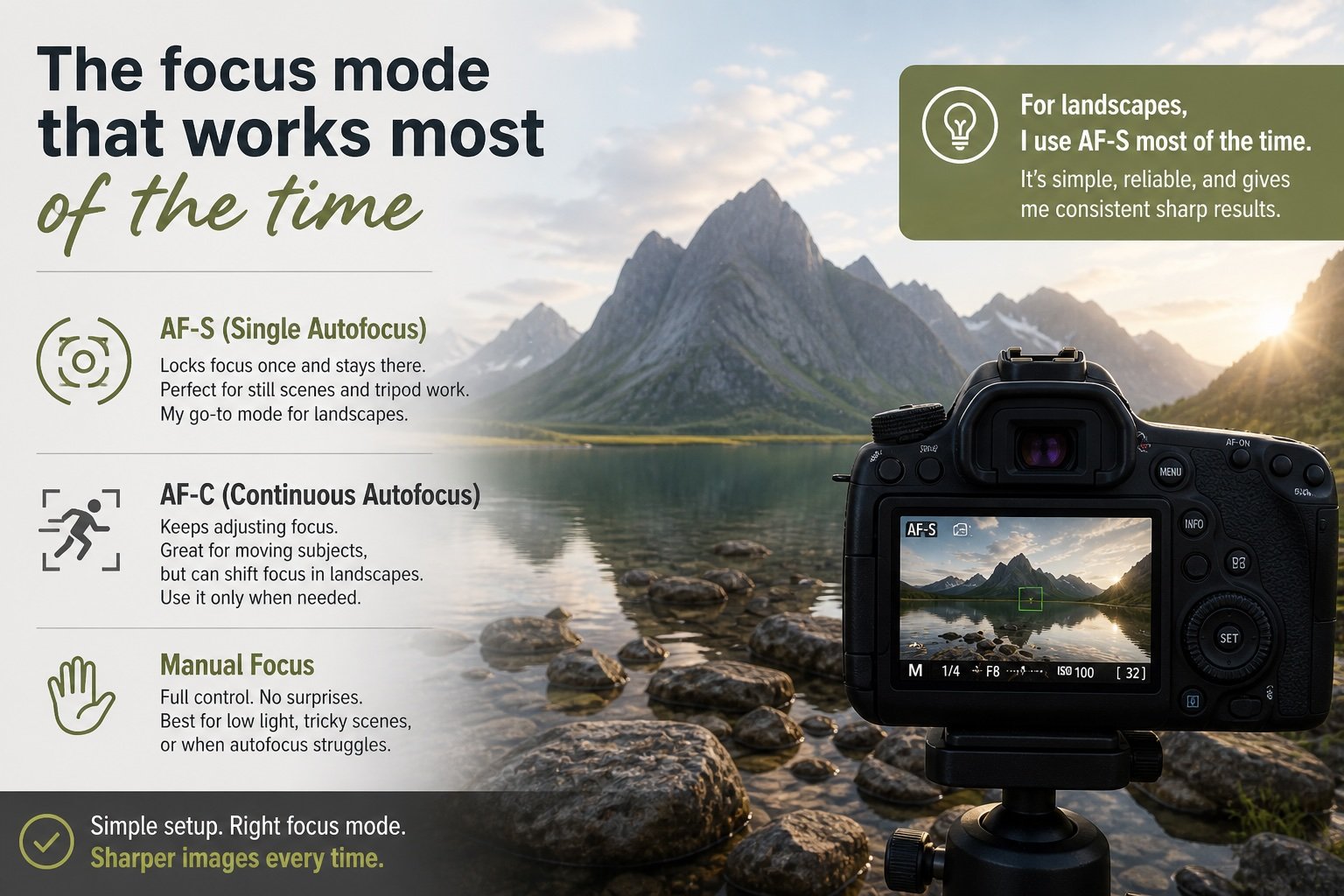
For landscapes, I keep things simple. I use AF-S most of the time.
It locks focus once and stays there. No surprises. No shifting. This matters especially when you are on a tripod and composing carefully.
AF-C has its place, but not here. It keeps adjusting focus, which is useful for moving subjects, but in landscapes it can change your focus point without you noticing. That’s how you lose sharpness even when everything looks fine on the screen.
Manual focus is something I use more as I shoot in more challenging light. Early morning, low contrast scenes, or when autofocus starts hunting. It gives you full control, but it takes a bit more patience.
Where most photographers get it wrong
The most common mistake I see is this.
People focus on the horizon.
It feels logical. The mountains, the skyline, the furthest point. That must be where the focus should go.
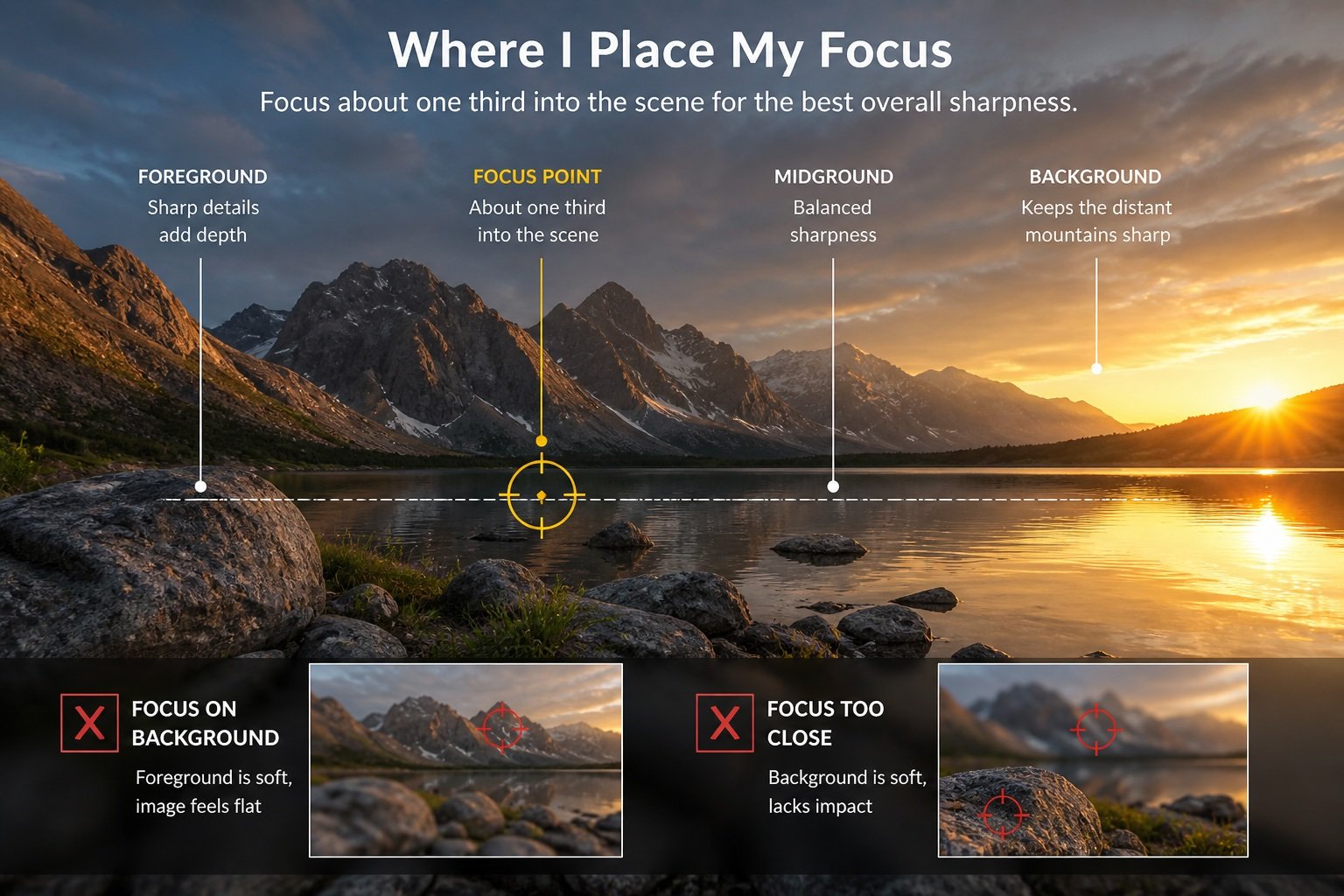
But when you do that, your foreground becomes soft. And the foreground is what gives your image depth and presence. Without it, the whole frame feels flat.
Where I place my focus
Instead of focusing on the furthest point, I focus somewhere into the scene.
A simple way to think about it is this. Aim roughly one third into your composition.
If I have a rock in the foreground, water in the midground, and mountains in the background, I won’t focus on the mountains. I’ll place my focus on the water or just beyond the foreground element.
This small shift changes everything. The image feels balanced, connected, and sharp across the frame.
Why focus area matters
Another thing that quietly affects sharpness is your focus area.
If you leave your camera on wide area autofocus, it decides what to focus on. Sometimes it gets it right. Many times it doesn’t.
I prefer to use single point autofocus. It gives me full control over exactly where the focus goes. No guessing. No surprises.
It’s a small habit, but it makes a big difference over time.
Common mistakes I see in the field
Relying on wide area autofocus and hoping the camera chooses correctly.
Focusing on the furthest point in the scene.
Recomposing too much after locking focus.
Letting autofocus struggle in low light instead of switching approach.
These are small things, but they add up quickly.
A few simple habits that help
When I want to be precise, I use live view and zoom in to check focus. It slows me down, but it saves the shot.
I keep my aperture around f8 to f11 for most landscapes. It gives me a good balance of sharpness and depth.
If I’m unsure, I take a second frame with a slightly different focus point. It’s a simple backup that often makes the difference later.
One thing to try next time
On your next shoot, keep it simple.
Use AF-S.
Switch to single point autofocus.
Place your focus about one third into the scene.
Then review your image properly. Zoom in. Look at the foreground, not just the background.
Final thought
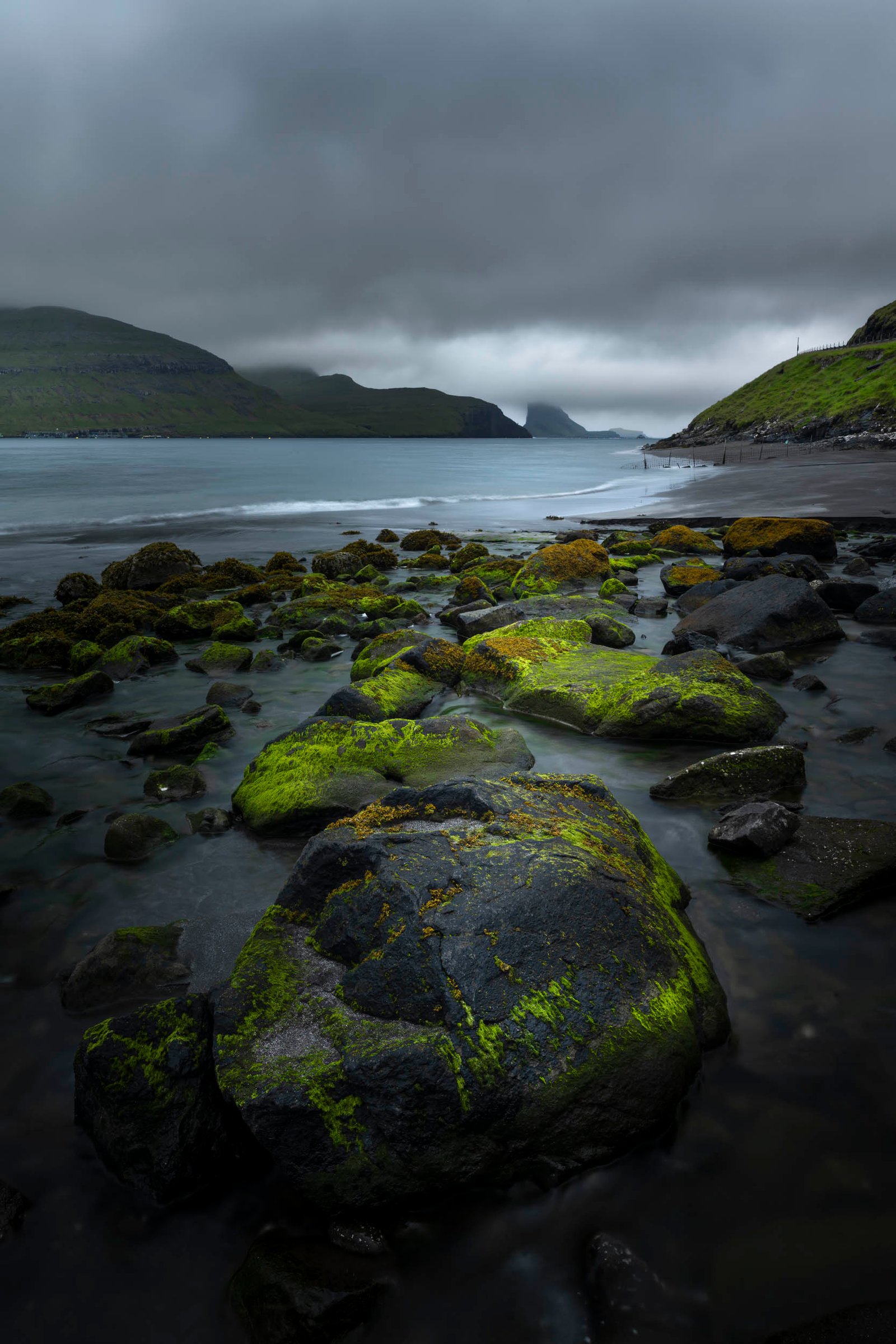
Sharp images are not about expensive gear. They come from small, deliberate decisions made in the field.
Metering controls your exposure. Focus controls your clarity.
Once you start paying attention to both, your images begin to feel complete.

I absolutely love reading your newsletter, Michael. This article perfectly answered my doubts on where to place my focus for landscape shots, Your tips on using AF-S and single-point autofocus to get a sharp image are every helpful to get sharp images. Thanks for sharing, and see you at the next workshop!