
You wait in silence.
It’s minus ten, your fingers are numb, and the first light is only just beginning to touch the horizon. For a while, nothing happens. The scene feels still, almost empty.
Then it shifts.
A single crane lifts its head, alert but calm. Another follows. Within moments, the entire group comes alive. Wings stretch, calls echo through the cold air, and just as the light breaks through the mist, they rise together.
Not one or two, but all of them.
You press the shutter, not because it’s beautiful, but because you sensed it coming.
That’s the difference.
Most people believe wildlife photography is about luck. Being in the right place at the right time and hoping something unfolds in front of them.
In reality, it’s about understanding behaviour.
When you begin to recognise patterns, everything changes. You stop reacting to what’s in front of you and start anticipating what’s about to happen. Small details begin to matter. A subtle shift in posture, a pause before movement, the way light builds before action.
This is where photography becomes intentional rather than accidental.
There’s a reason Hokkaido sits firmly on the bucket list of wildlife photographers around the world.
It’s not just about the species you can photograph, but the way winter transforms the environment. Snow simplifies the scene, removing distractions and creating clean, uncluttered backgrounds that allow your subject to stand out with clarity.
The light behaves differently here as well. It stays low, soft, and directional, creating long shadows and gentle contrast that adds depth without harshness. At the same time, the cold air introduces atmosphere that is difficult to replicate anywhere else. Mist rises from rivers at sunrise, breath becomes visible, and falling snow adds a quiet sense of motion to an otherwise still frame.
Then there is the wildlife itself.
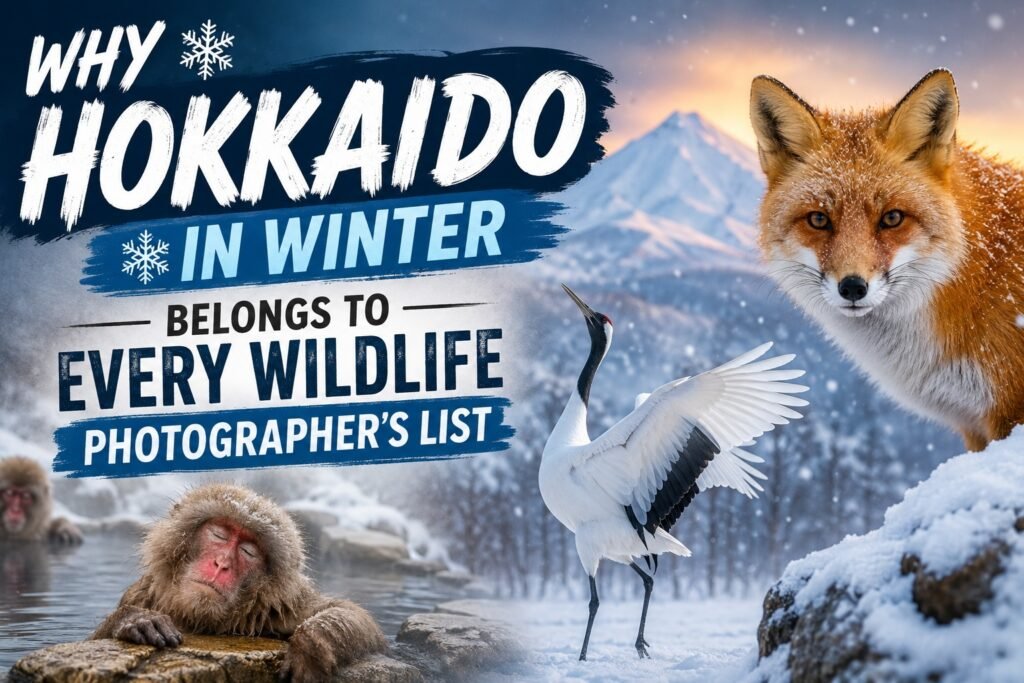
Red-crowned cranes gather and perform in open landscapes, offering moments of elegance and interaction. Sea eagles bring bursts of intensity as they hunt and compete, often in dramatic conditions over drift ice. And in the stillness of night, the rare Blakiston’s fish owl appears, offering one of the most unique encounters a wildlife photographer can experience.
It’s this combination of subject, light, and environment that makes Hokkaido so special. The conditions do more than support the photograph, they shape it.
And yet, many wildlife trips fail to deliver strong images.
They move too quickly from one location to another, offering only brief encounters and limited opportunities to understand what is happening. You see the subject, take a few frames, and move on.
The result is often a collection of records rather than meaningful photographs.
Without time, there is no understanding. And without understanding, there is no intention.
We’re about to launch our Hokkaido Winter Wildlife workshop with this in mind.
This is not designed as a sightseeing trip, but as a photography-first experience where time, patience, and repetition are built into the journey. Instead of rushing through locations, we stay, observe, and return when needed, allowing you to work with behaviour rather than against it.
You won’t just photograph cranes, you’ll begin to recognise when they are about to move. You won’t simply capture eagles in flight, you’ll learn how to position yourself before the action begins.
This shift is what leads to stronger, more deliberate images.
Throughout the workshop, the focus is on helping you refine how you see and respond in the field. You will learn to read behaviour, work with available light, and time your shots with purpose rather than chance. More importantly, you will start to build images that carry a sense of story, not just visual appeal.
Daryl Yeo will guide you through this process on location.
He has been photographing wildlife since 2011 and is known for a style that focuses on behaviour and environment rather than surface beauty alone. His work reflects a deep understanding of how animals interact with their surroundings, and that perspective shapes the way he teaches.
Daryl leads photography tours across Japan, Alaska, and Africa, and continues to study and photograph birdlife in Singapore, both resident and migratory. He is an award-winning photographer, an Associate of The Royal Photographic Society, and a Canon Singapore ambassador.
What he offers in the field is not just guidance on settings or composition, but a way of seeing that changes how you approach wildlife photography entirely.
The group is intentionally kept small, with a maximum of six participants, to ensure space and flexibility in the field. This allows you to move freely, refine your position, and revisit key subjects without pressure.
Because one opportunity is rarely enough.
Strong images are often the result of returning, adjusting, and trying again under better conditions.
This is not a relaxed holiday. The days can be cold, the mornings early, and the waits long.
But for those who are serious about improving their wildlife photography, these are the conditions where real progress happens.
You begin to move beyond simply capturing what is in front of you and start creating images with intention and meaning.
The workshop runs from 24 January to 1 February 2027 in Hokkaido.
You will have the opportunity to photograph red-crowned cranes, Steller’s sea eagles, Blakiston’s fish owl, and a range of winter wildlife within one of the most distinctive photographic environments in the world.
An early bird rate of SGD 5,990 is available for a limited time, before returning to the standard workshop fee of SGD 6,700.
With a small group, structured field guidance, and carefully planned sessions, the aim is simple. To give you the time and understanding needed to create images that truly stand out.
If this feels like the kind of experience you’ve been looking for, take a closer look.
See the full details and decide if this is your next step.
