
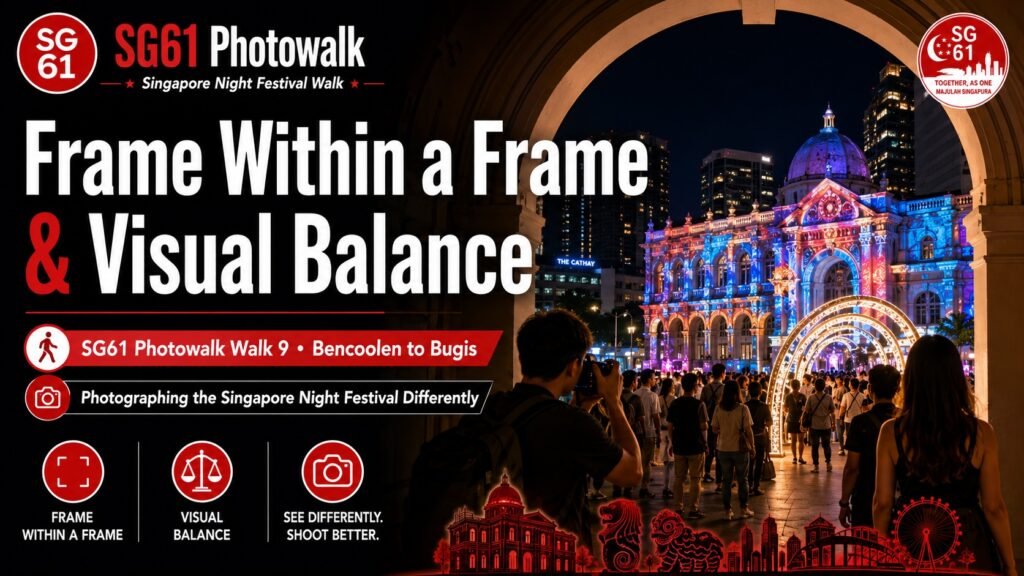
A night festival can be surprisingly difficult to photograph.
There are bright projections everywhere.
Crowds.
Signs.
Historic buildings.
Installations.
Everyone is pointing a camera at the same thing.
So for Walk 9, I don’t want us to simply record what the Singapore Night Festival looks like.
I’d like us to think more carefully about how we arrange all that visual information inside the frame.
This Wednesday, 2 September, our SG61 Photowalk will take us from Bencoolen MRT towards Bugis through the Bras Basah.Bugis festival precinct.
The Singapore Night Festival 2026 runs from 21 August to 5 September. On Wednesday, most festival works begin from around 7.30pm, which means our 6pm start also gives us some time to photograph the area as daylight changes into evening.
This week, we’ll practise two techniques.
Frame within a frame.
Visual balance and tension.
One helps tell the viewer where to look.
The other helps make the photograph interesting once they get there.
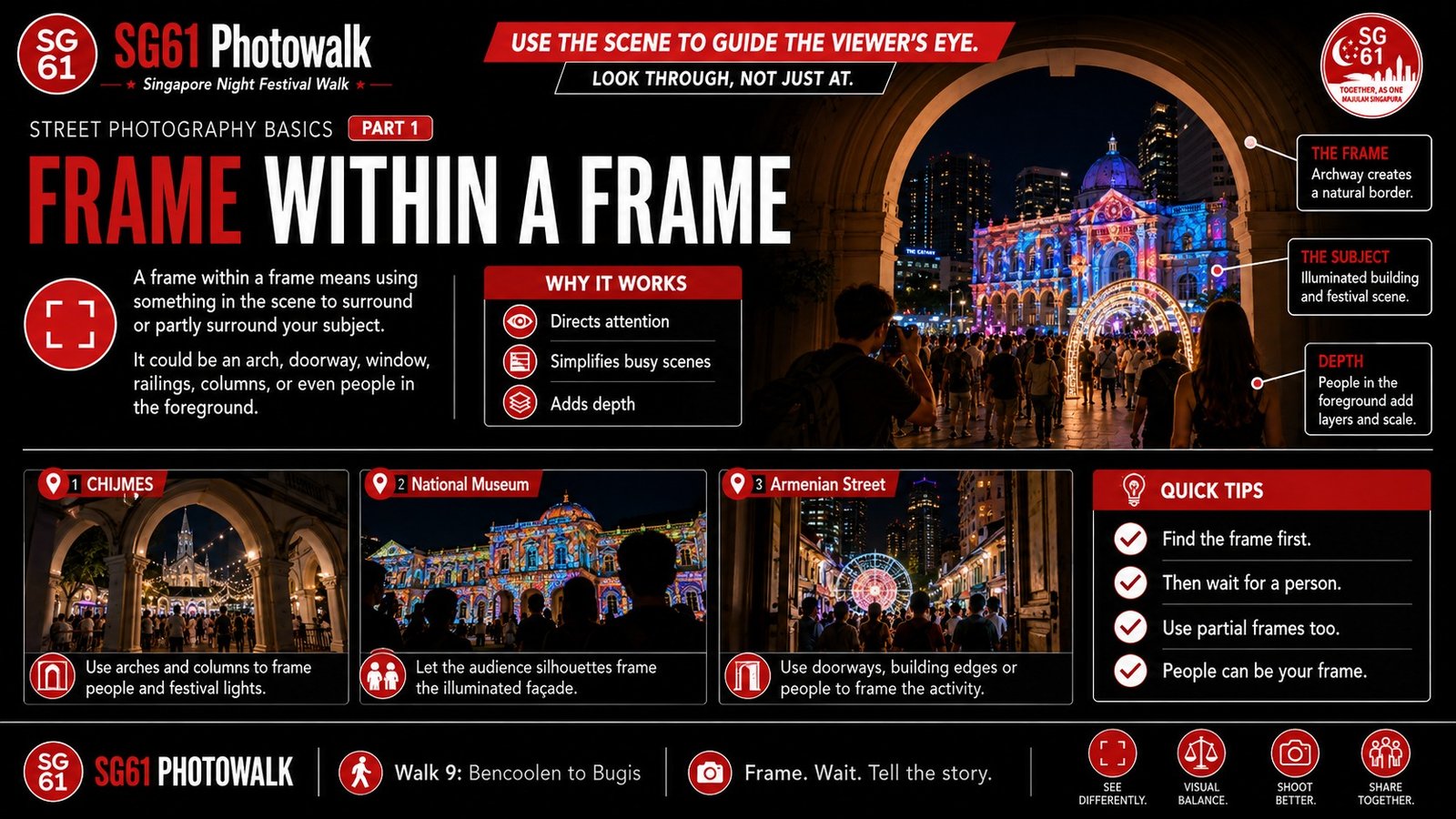
1. Frame within a frame
The idea is simple.
Find something in front of your subject and use it as another frame inside your photograph.
It could be:
- An arch
- A doorway
- A window
- Columns
- Railings
- Tree branches
- Two people standing in front of you
- A gap between people in a crowd
Your subject then appears inside that opening.
It’s a very useful technique when the surroundings are busy.
And a night festival is definitely busy.
Why framing works so well at night
At night, our eyes naturally jump towards the brightest areas.
That can make photographs feel messy when there are several illuminated objects competing for attention.
A frame helps control that.
Imagine standing inside a dark doorway and photographing a bright installation outside.
The dark edges contain the scene.
The illuminated subject immediately becomes more important.
You’ve simplified the photograph without actually removing anything.
Don’t photograph the frame
Finding an arch is not the photograph.
Finding a doorway is not the photograph either.
They only give you somewhere to start.
Once you find your frame, wait.
Let somebody walk into it.
Wait for someone to stop and look at the installation.
Wait until two people separate.
Wait until the projection reaches an interesting point.
The frame gives you structure.
The moment gives you the story.
Where to practise framing on Walk 9
The Cathay
The Cathay is hosting the MALAM Projection Mapping Competition, with the winning works projected across its historic façade during the second part of the festival.
Instead of photographing the whole façade straight on, look for something in the foreground.
A person.
A street sign.
A gap between other visitors.
Even the edge of another building.
Use it to contain the projection.
National Museum of Singapore
The National Museum is one of the main festival locations, with Tales of Earth and Sea projected across the building.
Try using people watching the projection as your foreground.
Photograph between shoulders.
Use silhouettes near the edge of the frame.
Let the audience become part of the composition instead of trying to remove everyone.
Sometimes the crowd can actually help frame the building.
Armenian Street
The official programme includes Vikings of the Tropics and Elsewhere along Armenian Street.
This area gives us heritage architecture, street activity and installations close together.
Look through doorways.
Use building edges.
Photograph through people.
You don’t always need a perfect architectural frame.
A partial frame can work just as well.
CHIJMES
CHIJMES should be one of our strongest places for this exercise.
Its arches and columns already give us natural frames, while Textures Through Time transforms the historic façade with projection mapping.
Try standing further back.
Find an arch.
Then wait for a person to enter the opening.
Instead of showing everything, show less.
Waterloo Centre
The official festival programme includes Touch Wood! at Artsplace @ Waterloo Centre.
Here, try using corridors, shopfronts, windows or people in the foreground.
Modern spaces can create frames just as effectively as old arches.
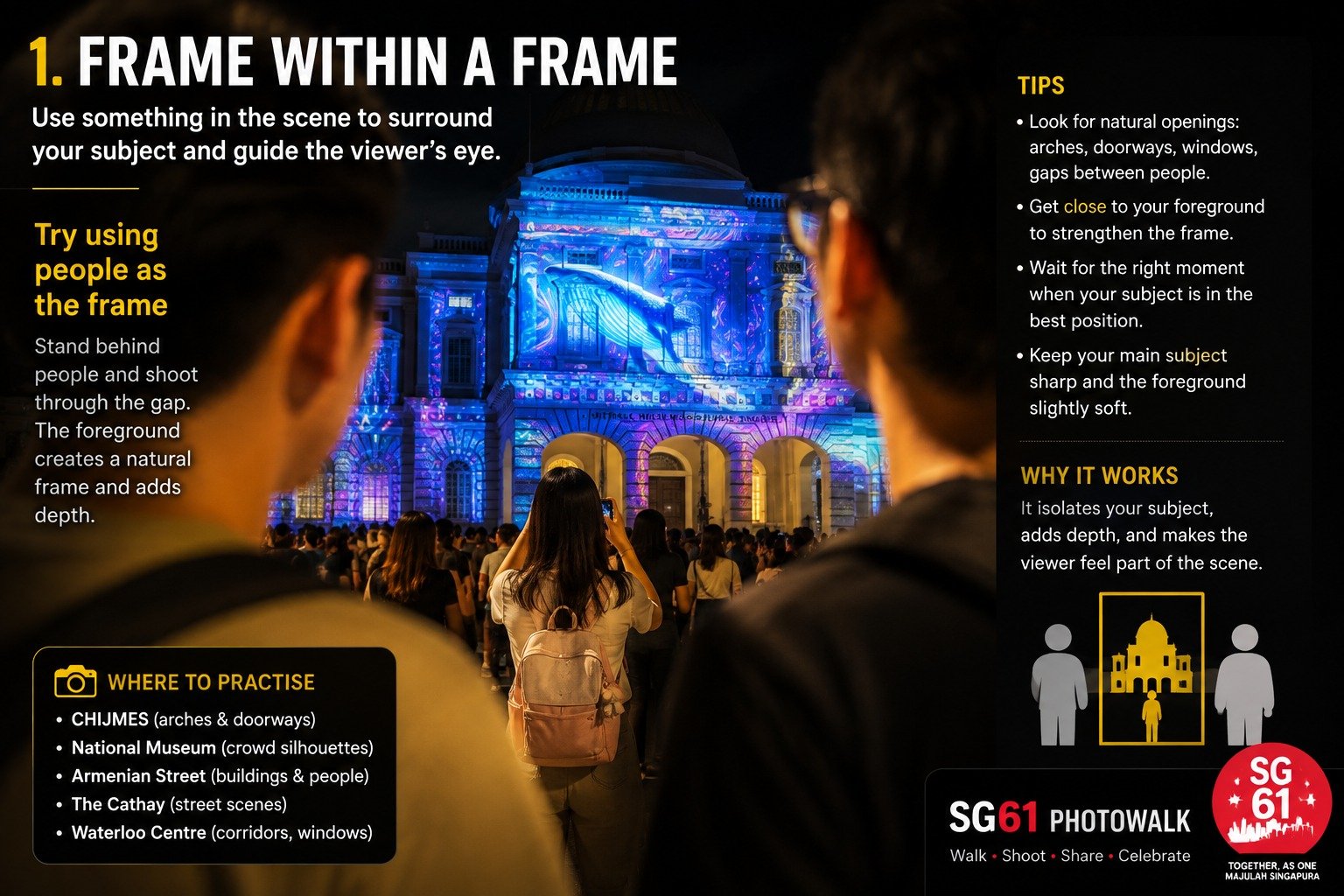
Try using people as the frame
This is one of my favourite variations.
Stand behind two people.
Photograph through the gap between them.
Or use a shoulder on one side of the image.
Maybe someone holding a phone becomes part of your foreground.
The foreground doesn’t even need to be sharp.
A slightly blurred person close to the camera can create depth and make the viewer feel as though they’re standing inside the festival with you.
2. Visual balance and tension
This one is slightly harder.
But once you start seeing it, your compositions can become much more interesting.
Most of us learn photography through simple rules.
Put the subject on a third.
Keep things straight.
Centre symmetrical subjects.
Those rules are useful.
But strong photographs don’t always need to feel perfectly neat.
Sometimes a little imbalance makes the viewer look longer.
Balance does not mean symmetry
Imagine one small person standing on the left side of your photograph.
On the right is a huge projection.
They are obviously not the same size.
Yet the photograph may still feel balanced.
Why?
Because the projection is bright and visually strong.
The person may be small, but we naturally notice people.
Both sides carry visual weight.
That is balance without symmetry.
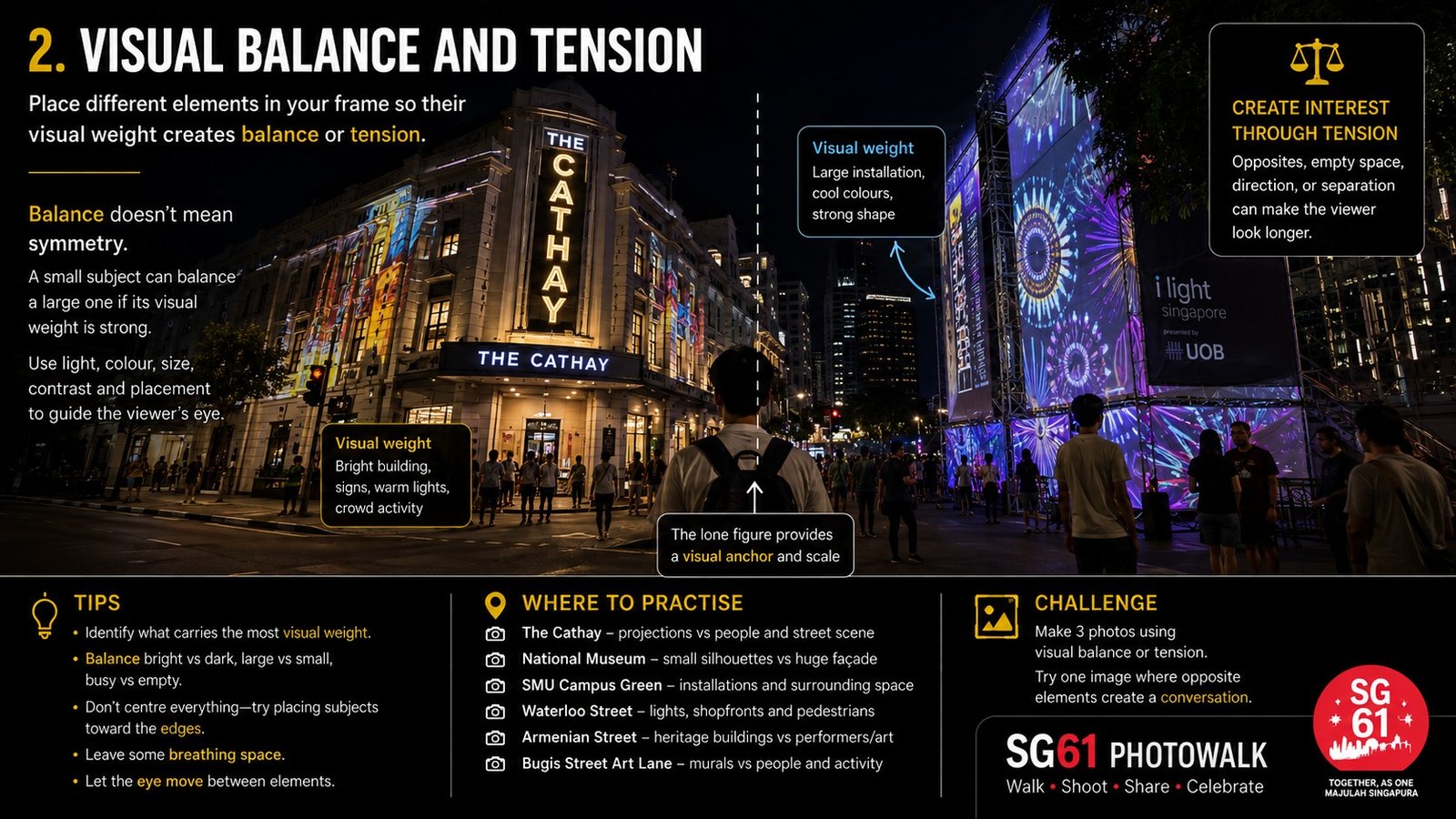
What has visual weight?
Some things pull our eyes more strongly than others.
Look for:
- Bright light
- Faces
- Human figures
- Strong colours
- Text
- Large shapes
- High contrast
- Familiar objects
A tiny person under a spotlight can sometimes balance half a building.
A small red sign can pull your eye as strongly as a much larger dark object.
Once you understand this, you stop thinking only about size.
You start thinking about attention.
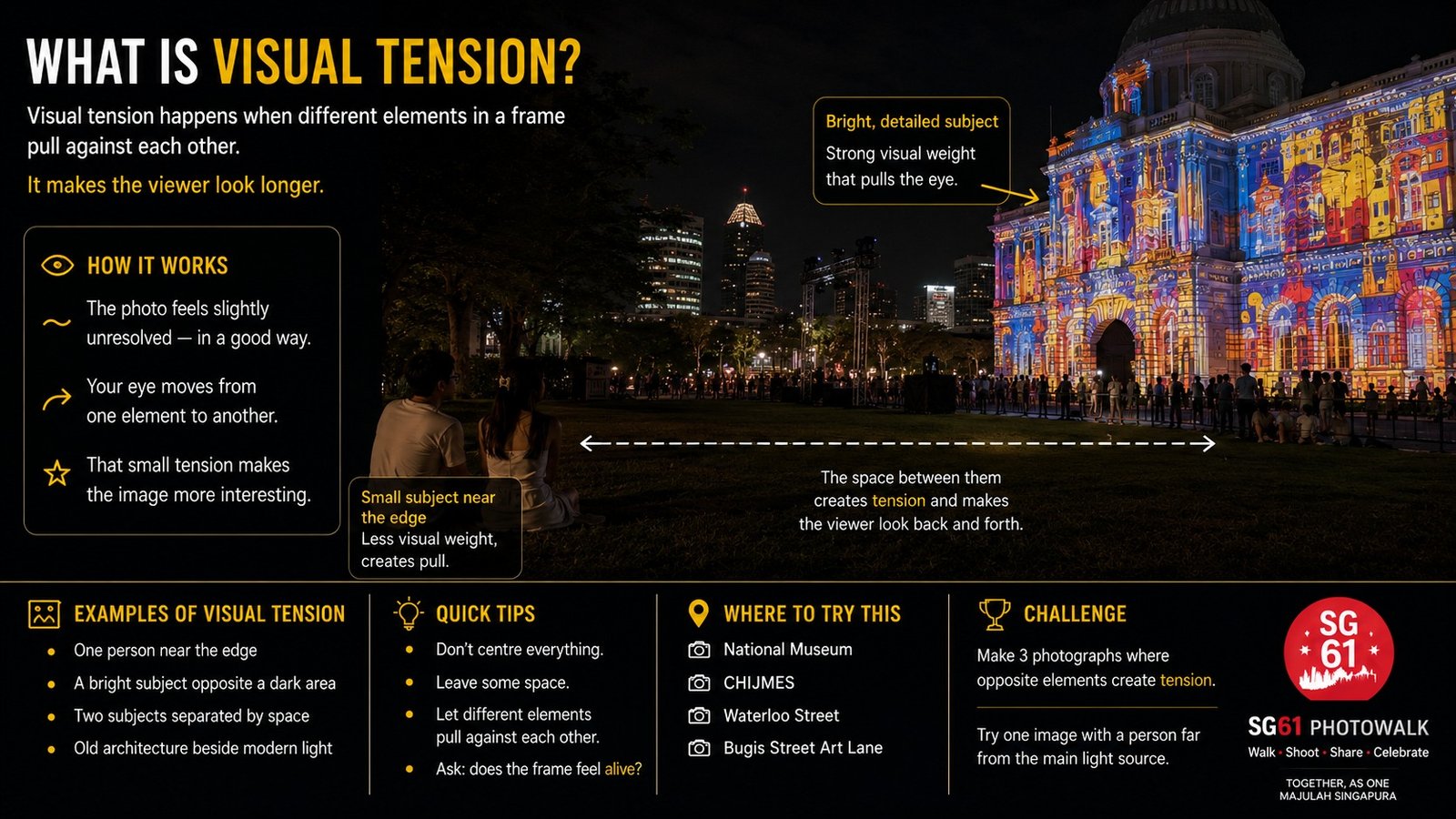
What is visual tension?
Visual tension happens when things don’t feel completely settled.
That can be interesting.
Maybe a person is close to the edge of the frame.
Maybe two people face opposite directions.
Maybe there is a big empty space between two subjects.
Maybe an old building and a futuristic projection seem to compete with each other.
Your eye moves backwards and forwards.
You start wondering how the elements relate.
That little question can keep someone looking at your photograph.
Try putting things further apart
Here’s a simple exercise.
Instead of bringing your subjects together, separate them.
One on the left.
One on the right.
Leave some space between them.
Then look through your viewfinder.
Does the empty space connect them?
Or does it create tension between them?
There is no single correct answer.
You’re learning to feel when the frame works.
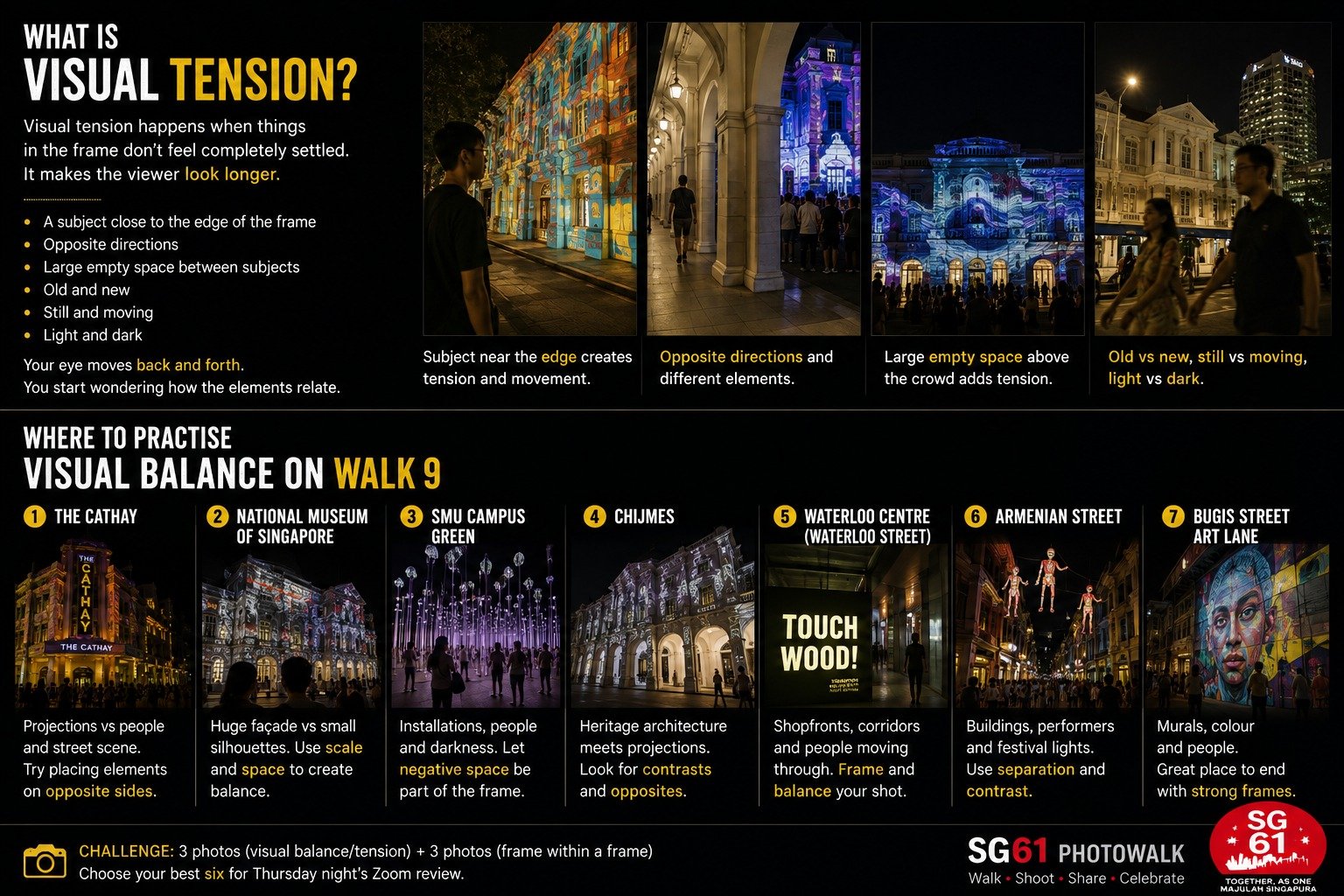
Where to practise visual balance on Walk 9
The Cathay
The projection gives you one strong visual element.
Now look for another.
Perhaps one person on the opposite side.
A group of spectators.
A street sign.
Don’t automatically centre everything.
Let the different elements pull against each other.
National Museum of Singapore
This is a perfect place to play with scale.
A huge illuminated façade.
One tiny human figure.
Try putting the person away from the centre.
Let the building occupy most of the frame.
The size difference creates both balance and tension.
SMU Campus Green
The official festival map lists several works here, including TRACES and You and I, Believing….
These installations give us another chance to work with people, illuminated objects and darker surrounding spaces.
Don’t feel you need to fill every empty area.
Darkness can be part of your composition too.
CHIJMES
Historic architecture plus projection mapping creates natural visual tension.
Old structure.
New light.
Still building.
Moving audience.
Look for these opposites.
They’re often more interesting than a perfectly clean postcard photograph.
Bugis Street Art Lane
Our route finishes towards Bugis, where the official programme places Stormy Straits at Bugis Street Art Lane.
This should give us strong forms, colour and people moving through the installation.
Try placing the artwork on one side and a person on the other.
See whether they feel connected.
If they do, wait.
Something else may happen.
Use darkness as part of the photograph
At a night festival, there is a temptation to brighten everything.
Don’t.
Dark areas are useful.
If one side of your photograph is bright and busy, the opposite side may need some darkness.
That empty black space gives the eye somewhere to rest.
It can also make the illuminated subject feel even stronger.
Sometimes the best thing you can do is leave part of the photograph alone.
Frame within a frame and visual balance can work together
This is where the exercise becomes fun.
Imagine standing beneath an arch at CHIJMES.
The arch creates your frame.
Inside it, someone stands on the left.
A bright projection fills the right.
Now you have a frame within a frame.
You also have visual balance.
And perhaps a little tension.
Or imagine standing behind two people watching the National Museum projection.
Their silhouettes create your foreground frame.
The museum fills the background.
One person looks towards the projection while the other turns away.
Now something is happening.
It is no longer simply a photograph of an installation.
It is a photograph about experiencing the festival.
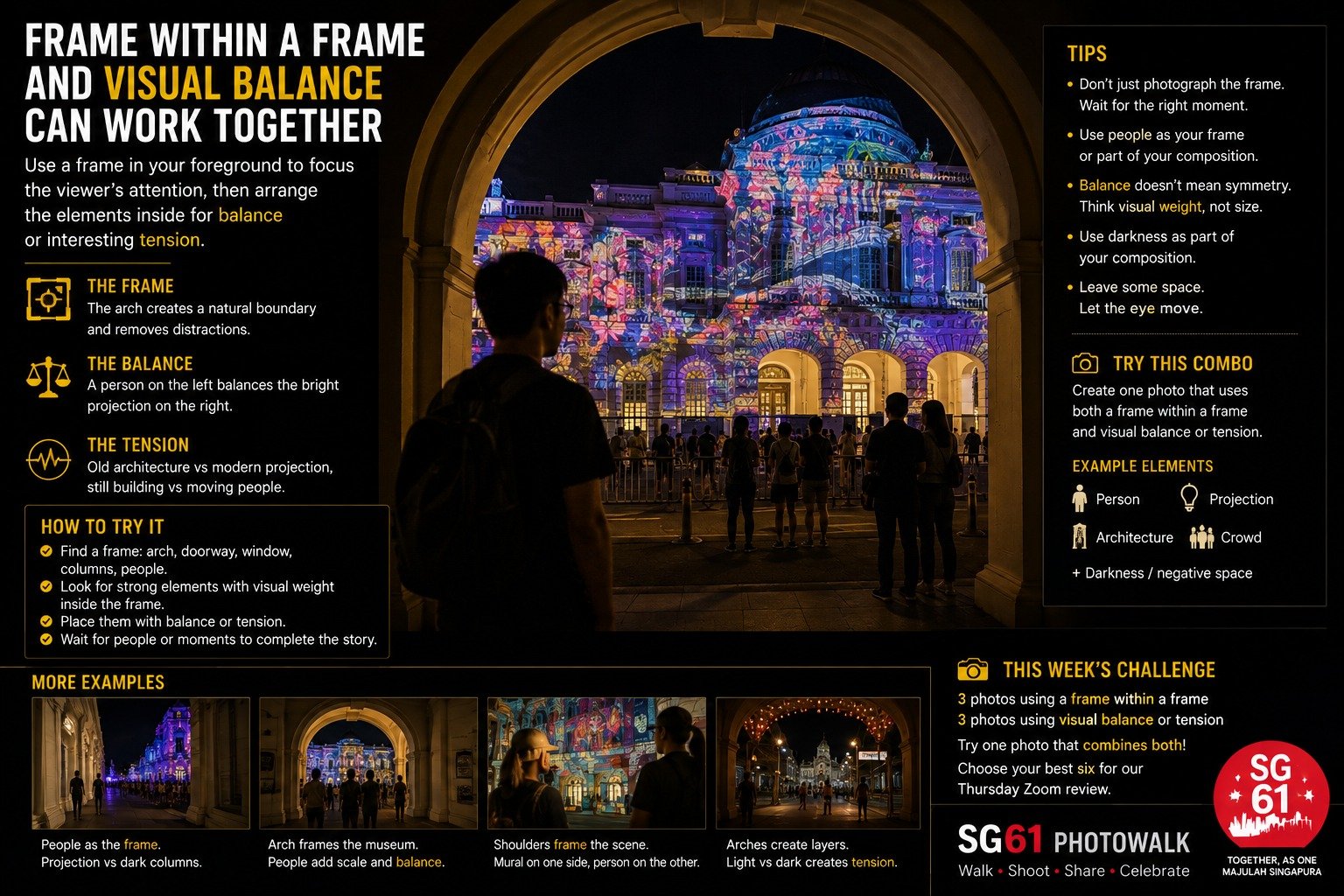
This week’s SG61 challenge
For Walk 9, try to create:
- 3 photographs using a frame within a frame
- 3 photographs where visual balance or tension makes the image work
For at least one framing photograph, don’t use architecture. Use people or another foreground object instead.
For at least one visual-balance photograph, deliberately keep your main subject away from the centre.
And if you can, try one photograph that combines both techniques.
Then choose your favourite six images for our Thursday Zoom review.
Don’t just photograph the festival
The Singapore Night Festival already gives us spectacular subjects.
Projection mapping.
Light installations.
Historic architecture.
Crowds.
Colour.
That part is easy.
Our challenge is deciding what to do with all of it.
Find a frame.
Decide where you want the viewer to look.
Notice what carries visual weight.
Use the darkness.
Leave some space.
And wait for people to complete the picture.
The festival provides the ingredients.
Our job is to arrange them.
See you at Bencoolen MRT.
Michael
