
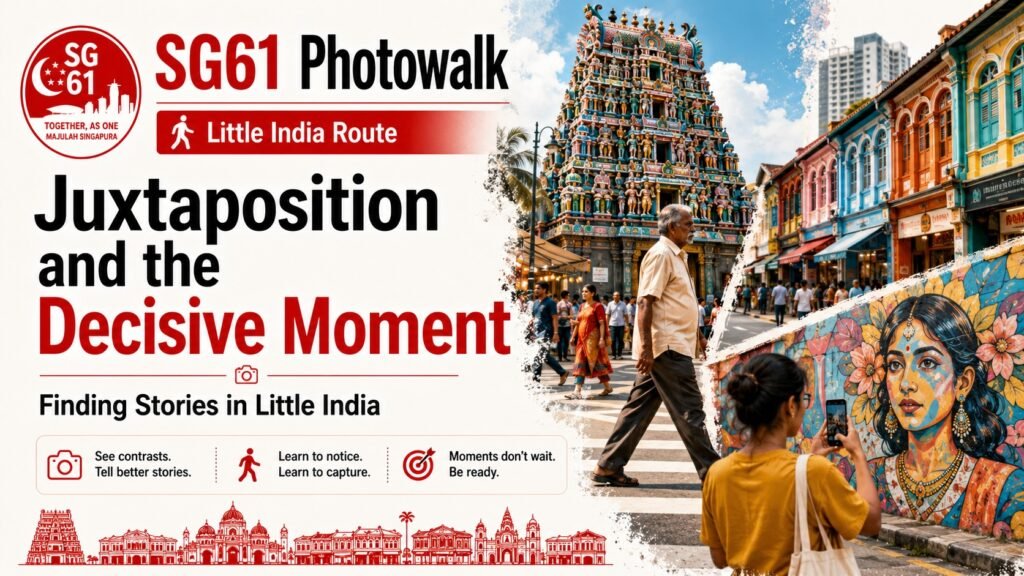
Little India is full of photographs before you even lift the camera.
Colourful shophouses.
Temple details.
Street art.
Food stalls.
People rushing past.
People stopping to talk.
People simply going about their day.
This Wednesday, our SG61 Photowalk takes us around Little India, starting and ending at Little India MRT.
For this walk, I’d like us to focus on two simple ideas.
Juxtaposition.
The decisive moment.
Both are really about the same thing.
Learning to notice relationships and timing.
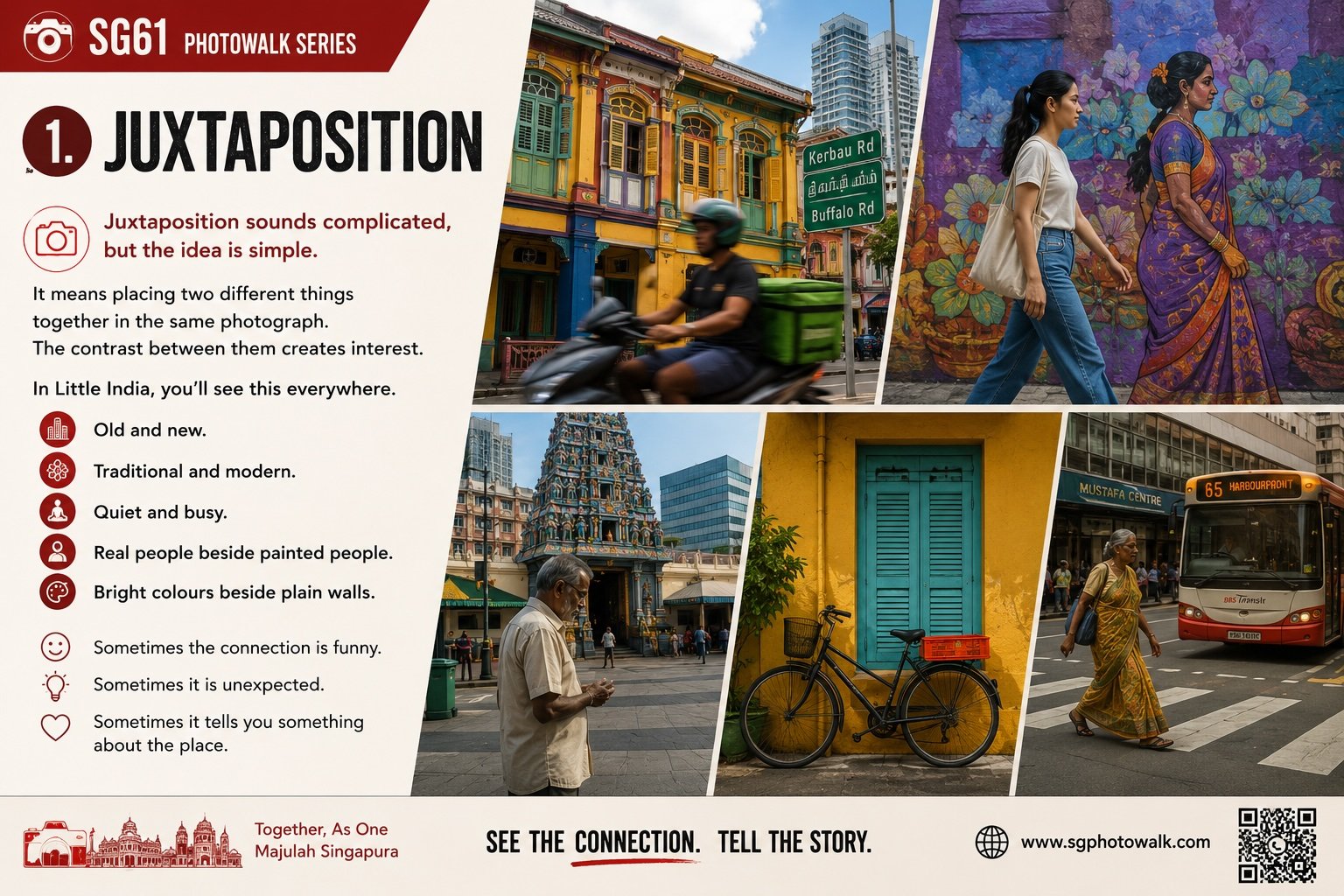
1. Juxtaposition
Juxtaposition sounds complicated, but the idea is simple.
It means placing two different things together in the same photograph.
The contrast between them creates interest.
In Little India, you’ll see this everywhere.
Old and new.
Traditional and modern.
Quiet and busy.
Real people beside painted people.
Bright colours beside plain walls.
Sometimes the connection is funny.
Sometimes it is unexpected.
Sometimes it tells you something about the place.
Look for relationships
A good juxtaposition photograph is not just two random things in the frame.
There should be some kind of relationship between them.
Maybe a person wearing red walks past a red doorway.
Maybe someone stands beside a mural that seems to copy their pose.
Maybe a modern car passes an old shophouse.
Maybe a worshipper stands quietly while the street around them is full of movement.
That small connection is what makes the photograph work.
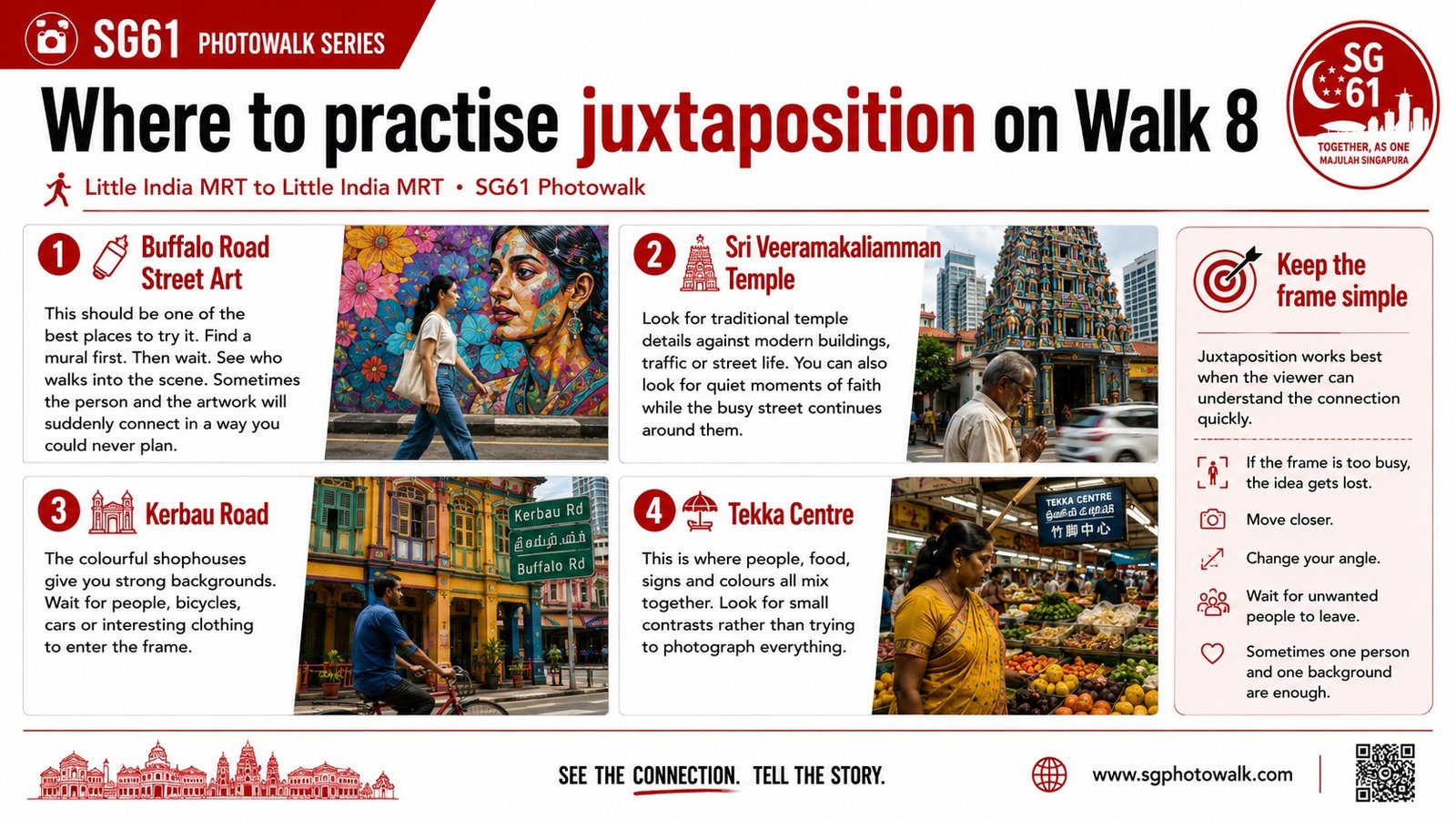
Where to practise juxtaposition on Walk 8
Buffalo Road Street Art
This should be one of the best places to try it.
Find a mural first.
Then wait.
See who walks into the scene.
Sometimes the person and the artwork will suddenly connect in a way you could never plan.
Sri Veeramakaliamman Temple
Look for traditional temple details against modern buildings, traffic or street life.
You can also look for quiet moments of faith while the busy street continues around them.
Kerbau Road
The colourful shophouses give you strong backgrounds.
Wait for people, bicycles, cars or interesting clothing to enter the frame.
Tekka Centre
This is where people, food, signs and colours all mix together.
Look for small contrasts rather than trying to photograph everything.
Keep the frame simple
Juxtaposition works best when the viewer can understand the connection quickly.
If the frame is too busy, the idea gets lost.
Move closer.
Change your angle.
Wait for unwanted people to leave.
Sometimes one person and one background are enough.
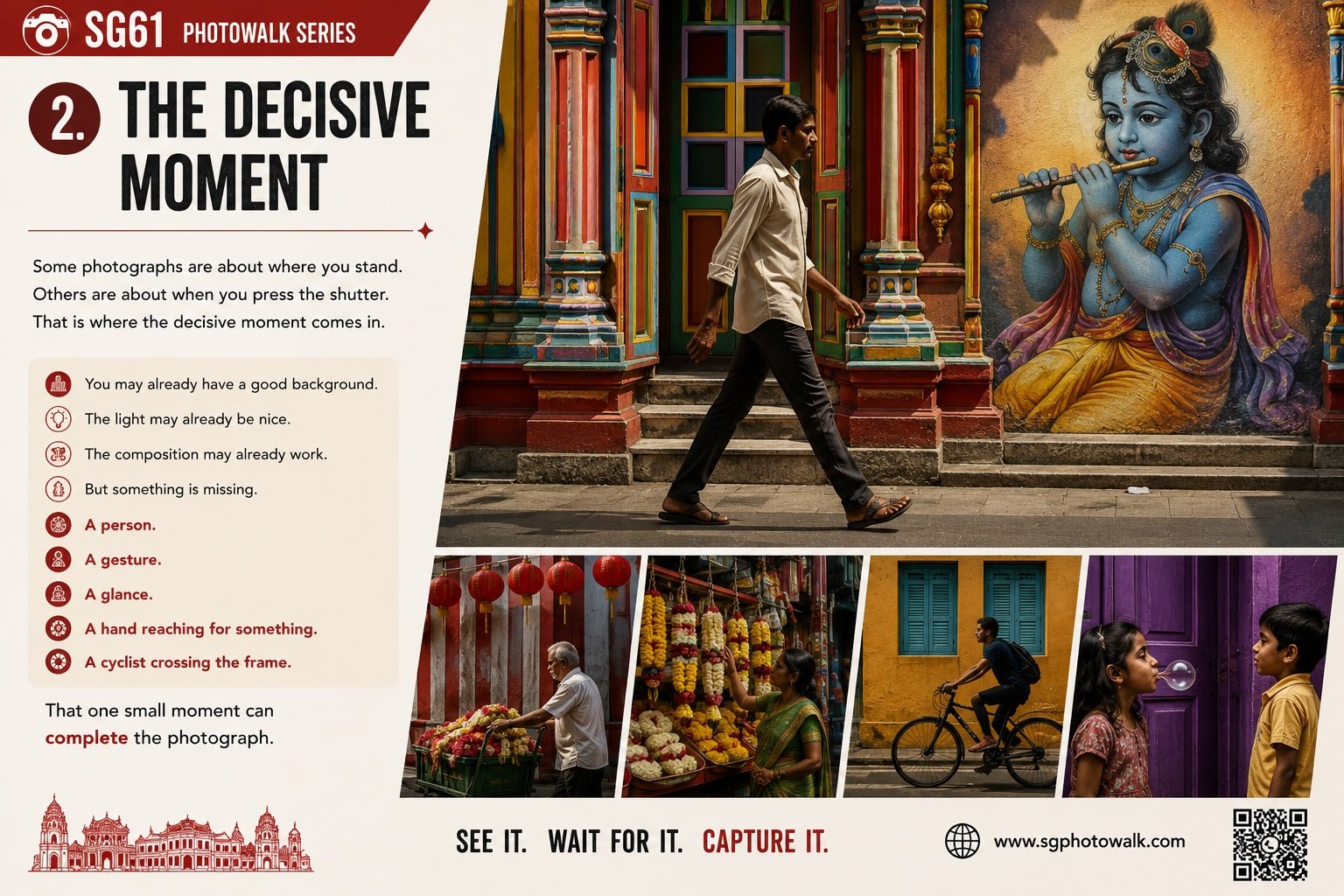
2. The decisive moment
Some photographs are about where you stand.
Others are about when you press the shutter.
That is where the decisive moment comes in.
You may already have a good background.
The light may already be nice.
The composition may already work.
But something is missing.
A person.
A gesture.
A glance.
A hand reaching for something.
A cyclist crossing the frame.
That one small moment can complete the photograph.
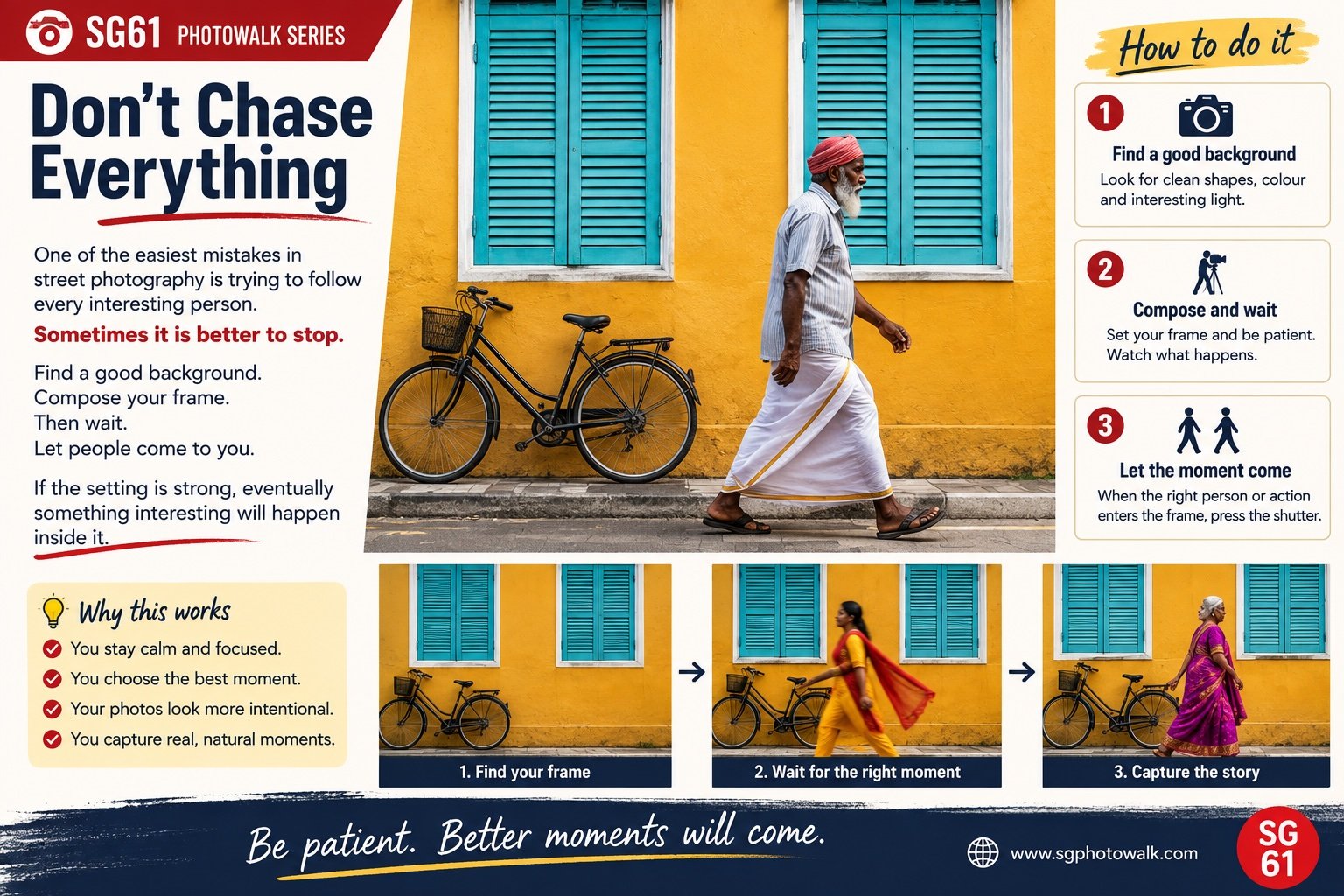
Don’t chase everything
One of the easiest mistakes in street photography is trying to follow every interesting person.
Sometimes it is better to stop.
Find a good background.
Compose your frame.
Then wait.
Let people come to you.
If the setting is strong, eventually something interesting will happen inside it.
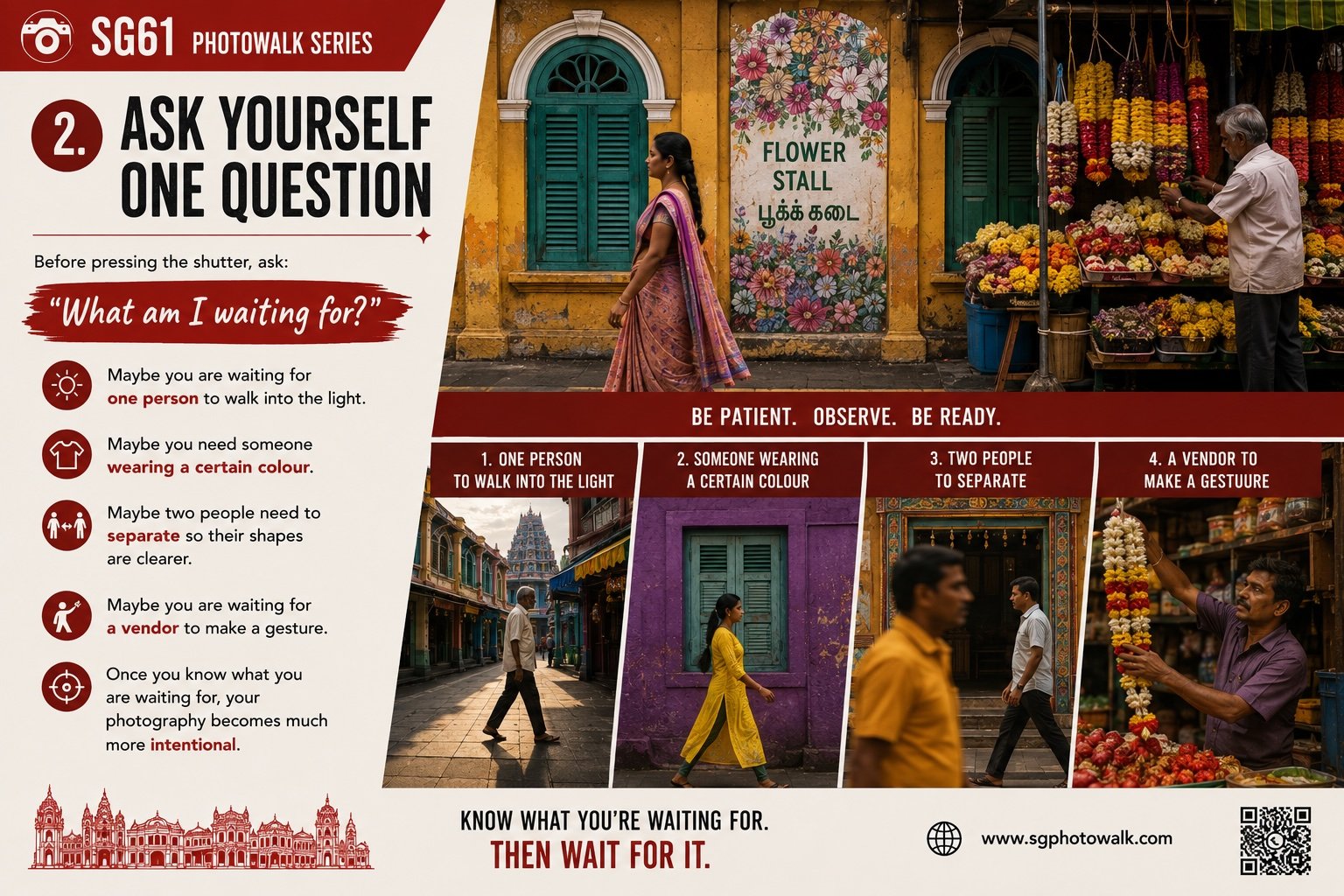
Ask yourself one question
Before pressing the shutter, ask:
What am I waiting for?
Maybe you are waiting for one person to walk into the light.
Maybe you need someone wearing a certain colour.
Maybe two people need to separate so their shapes are clearer.
Maybe you are waiting for a vendor to make a gesture.
Once you know what you are waiting for, your photography becomes much more intentional.
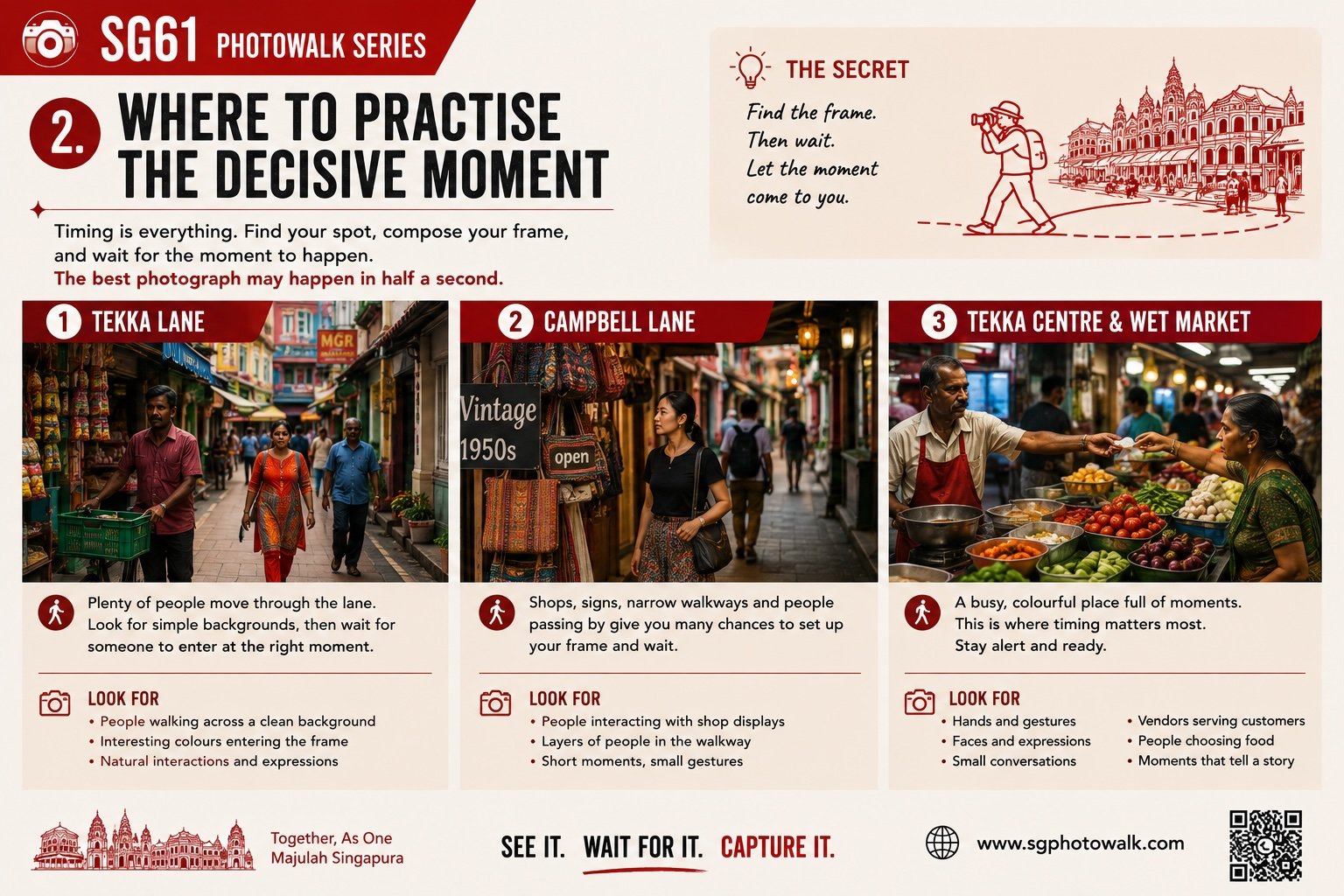
Where to practise the decisive moment on Walk 8
Tekka Lane
There should be plenty of people moving through the street.
Look for simple backgrounds, then wait for someone to enter at the right moment.
Campbell Lane
Shop displays, narrow walkways and people passing by give you many chances to set up a frame and wait.
Tekka Centre and Wet Market
This could be the strongest location for timing.
Watch hands.
Faces.
Small conversations.
Vendors serving customers.
People choosing food.
The best photograph may happen in half a second.
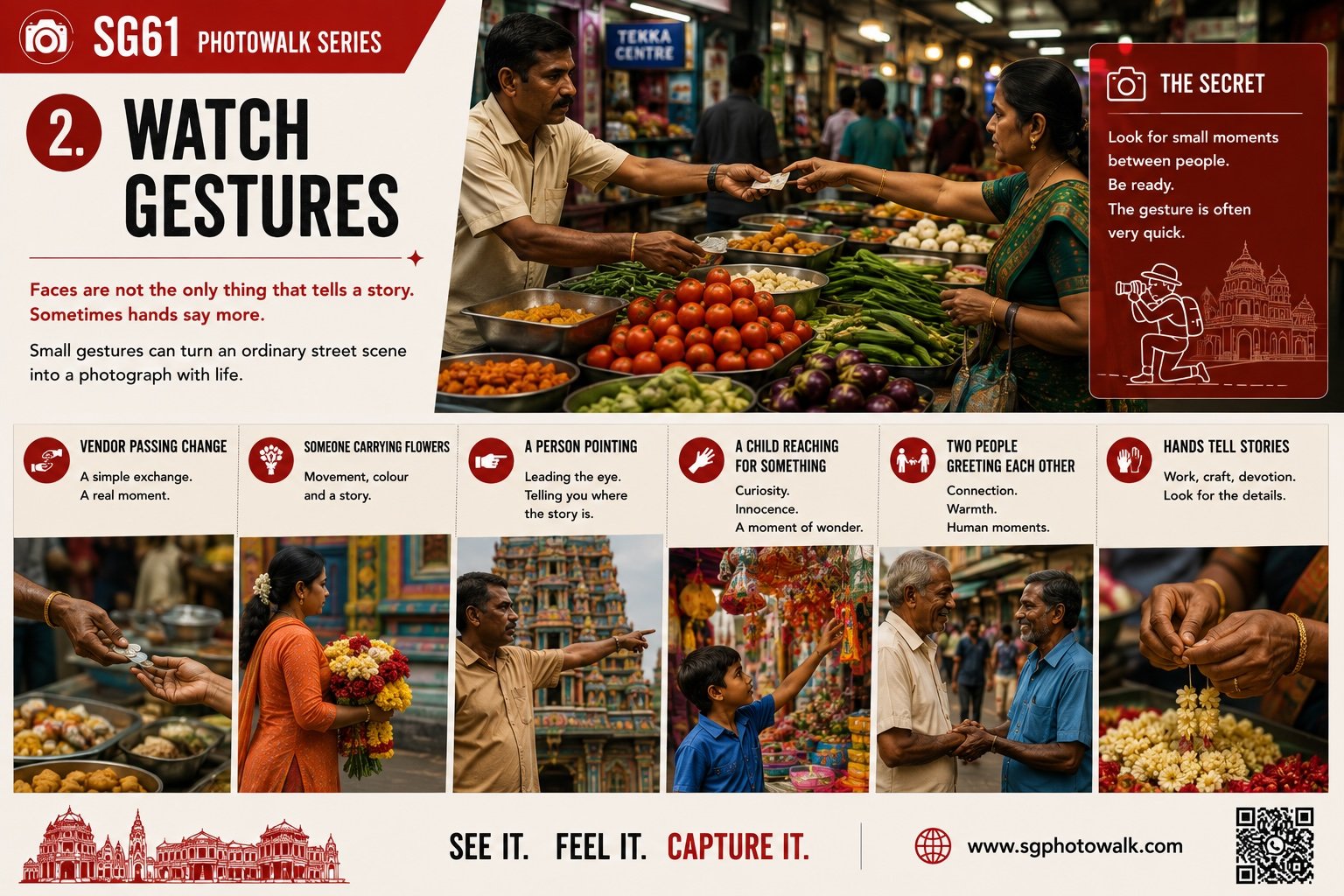
Watch gestures
Faces are not the only thing that tells a story.
Sometimes hands say more.
A vendor passing change.
Someone carrying flowers.
A person pointing.
A child reaching for something.
Two people greeting each other.
These small gestures can turn an ordinary street scene into a photograph with life.
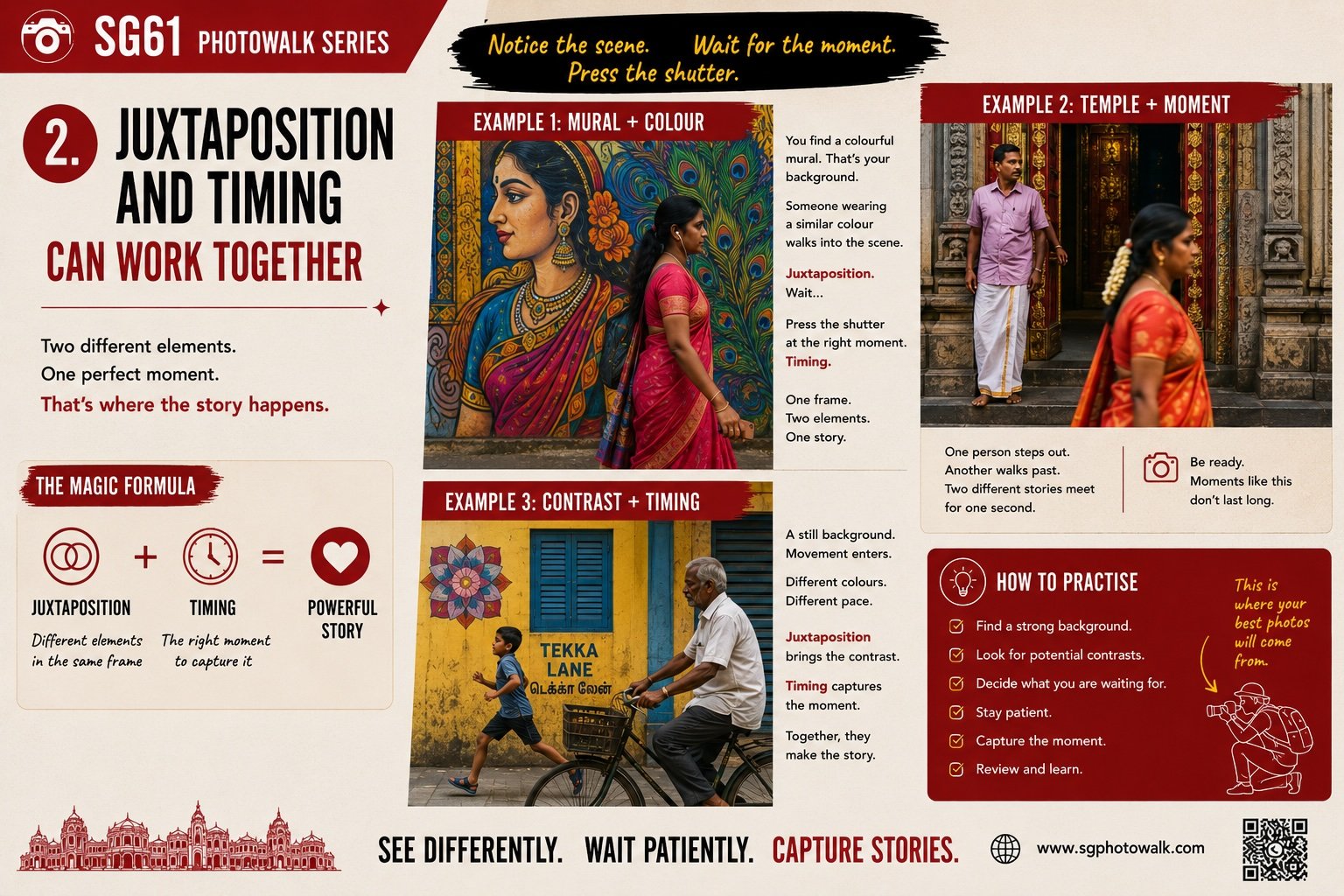
Juxtaposition and timing can work together
This is where things get really interesting.
Imagine you find a colourful mural.
That is your background.
Then someone wearing a similar colour walks past.
Now you have juxtaposition.
If you press the shutter at exactly the right moment, you also have timing.
Or perhaps a person walks past a temple entrance just as another person steps out.
Two different stories meet for one second.
That is street photography.
This week’s SG61 challenge
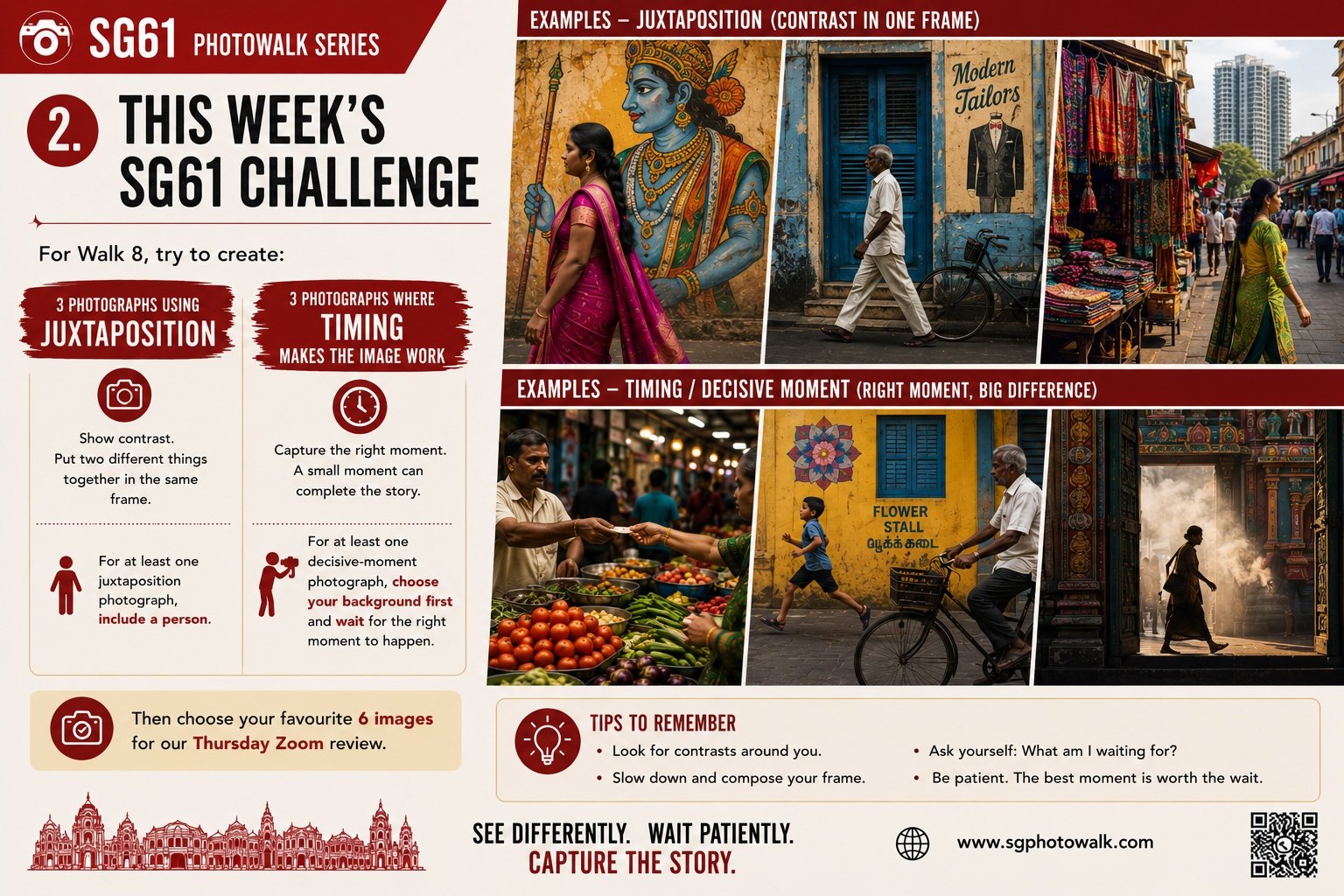
For Walk 8, try to create:
-
3 photographs using juxtaposition
-
3 photographs where timing makes the image work
For at least one juxtaposition photograph, include a person.
For at least one decisive-moment photograph, choose your background first and wait for the right moment to happen.
Then choose your favourite 6 images for our Thursday Zoom review.
Look for stories, not just subjects
Little India is an easy place to photograph.
There is colour everywhere.
There are beautiful buildings everywhere.
There are people everywhere.
The harder part is deciding what the photograph is really about.
This Wednesday, try not to photograph everything you see.
Look for connections.
Wait for moments.
Let people enter your frame.
And when two things suddenly come together, be ready.
That may be the photograph.
See you at Little India MRT.
Michael
