
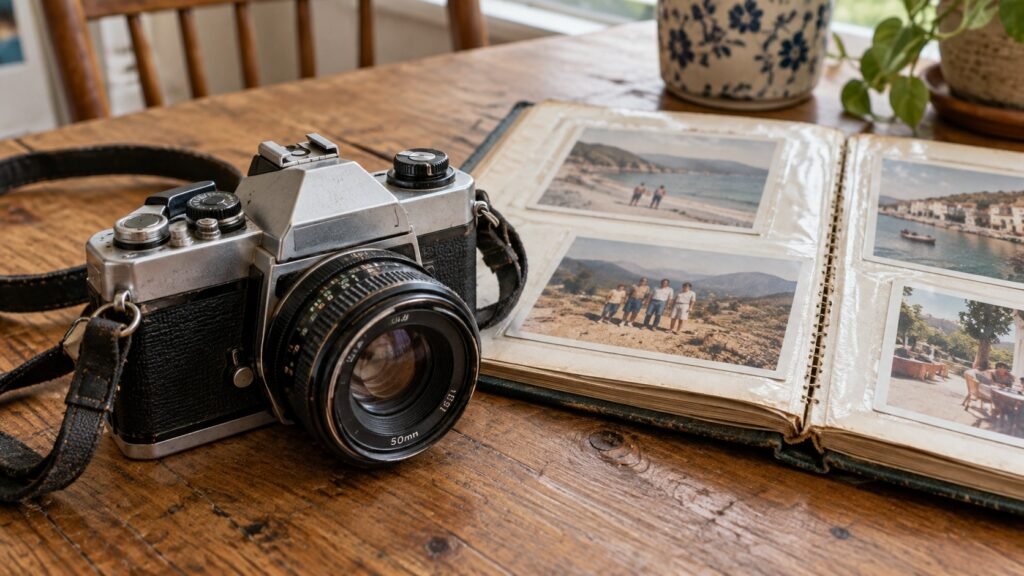
My first lessons in photography came from my mum. Some of them involved getting scolded.
I was in primary school, and my younger sister was still in kindergarten. Mum had a film camera and loved taking pictures of us. She also liked being in the photographs, which meant handing the camera over and trusting us to take her picture.
That didn’t always go well.
Sometimes, I forgot to turn the film advance knob after taking a photograph. Other times, we opened the back of the camera and exposed the film to light, ruining the pictures.
At that age, I didn’t fully understand what was happening inside the camera. I just knew there were things we were supposed to do, and forgetting them could get us into trouble.
A whole holiday, and no photographs
Even loading the film could go wrong.
We thought we’d fitted the roll properly. We took pictures throughout the holiday, believing the camera was recording everything.
Then we sent the film to the shop and discovered we had no photographs.
It’s a disappointing feeling. You remember taking the pictures. You remember the places and the people. But there’s nothing to collect.
Today, I can look at the back of my digital camera and know immediately whether I’ve captured something. Back then, we had to trust that everything was working.
Sometimes, it wasn’t.
The wait was part of the experience
In my memory, it could take about two weeks before the photographs were ready.
The anticipation was real. Had the pictures turned out? Had we loaded the film correctly? Would there be anything worth keeping?
We couldn’t check. We had to wait.
But when everything worked, collecting the photographs felt so rewarding.
We’d flip through them one by one, seeing our holiday again. After all that waiting, we finally had pictures we could hold, pass around and keep.
I still remember that feeling.
What digital has given us
I wouldn’t want to give up the convenience of digital photography.
Being able to check exposure, focus and composition immediately is useful. We can spot a mistake while there’s still time to try again. We can experiment and learn from the result straight away.
And we don’t have to wait until after a holiday to discover that we have no pictures.
But having room for thousands of photographs makes it easy to keep pressing the shutter.
I do it too. I take another frame, then another, even when I haven’t quite decided what I’m trying to improve.
With film, the remaining frames gave us a reason to stop and think. With digital, we have to make that choice ourselves.
What would you photograph with just 36 frames?
Imagine going for a walk with only 36 photographs available.
Would you take the picture in front of you, or keep walking?
You might spend a little longer watching the light. You might notice something distracting at the edge of the frame and move a few steps. You might wait for someone to enter the scene before pressing the shutter.
Taking fewer photographs doesn’t automatically make them better. Sometimes, trying several frames is exactly how we find the photograph we want.
But a limit can help us notice our habits.
It gives us a reason to ask whether we’re ready to take the picture, or whether we need to look a little longer.
The camera has a story too
An old camera can hold memories even when it no longer works.
Perhaps it belonged to your mum or dad. Perhaps it was your first camera, bought after saving for months. It might have travelled with you, photographed your children growing up, or spent years forgotten in a cupboard.
When I think about my mum’s camera, I remember her taking our pictures and asking us to take hers.
I remember the mistakes, the waiting and the relief when the photographs turned out.
That’s what I’d like us to share through our Vintage Camera Walks.
Join our Vintage Camera Walk series
We’re starting a series of five walks, or chapters, with our first walk this Saturday.
For each chapter, bring an old camera. It can be working or no longer working. Both are welcome.
If your camera works, we’ll use it to take 36 photographs during the walk. The idea is to choose each shot carefully before pressing the shutter, just as we had to when every frame used a little more of the roll.
If your camera doesn’t work, bring it along anyway. You can still join the walk and share the memories that come with it.
Afterwards, we’ll gather at a café and tell the stories behind our cameras. Who did yours belong to? Where did you take it? What photographs do you remember making with it?
I’d love to hear its story, and I’m sure the others will too.
Visit sgphotowalk.com for the first chapter’s details and registration.
See you on Saturday. Bring your old camera and a story to share.
Michael
