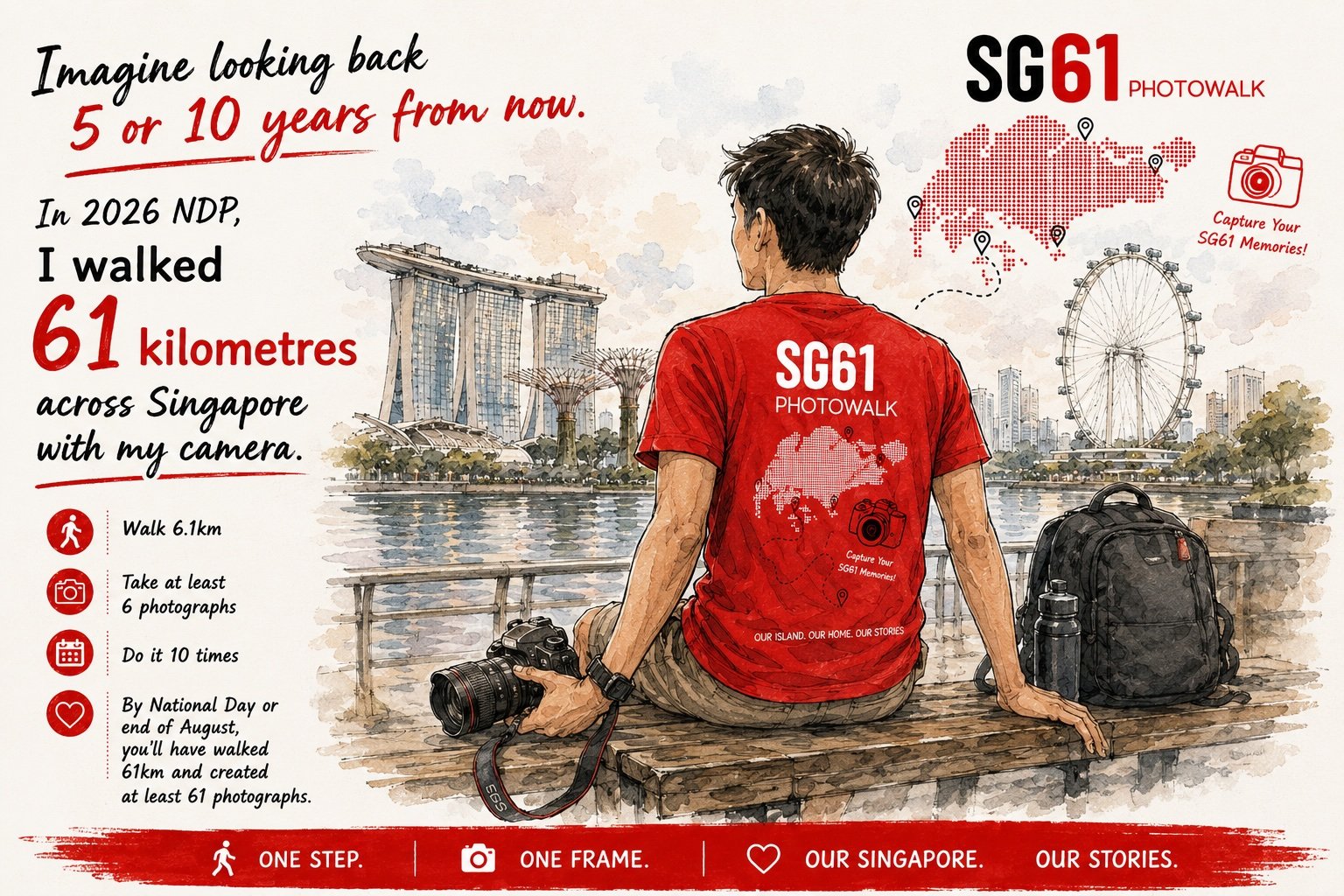

Sometimes the hardest thing in photography is not finding more.
It is learning to remove.
This Wednesday, our fifth SG61 Photowalk takes us from Botanic Gardens MRT to Napier MRT through the Singapore Botanic Gardens.
After four walks through busy streets and city scenes, this one gives us something different.
More space.
More greenery.
More time to slow down.
And that makes it a perfect place to practise two useful photography techniques.
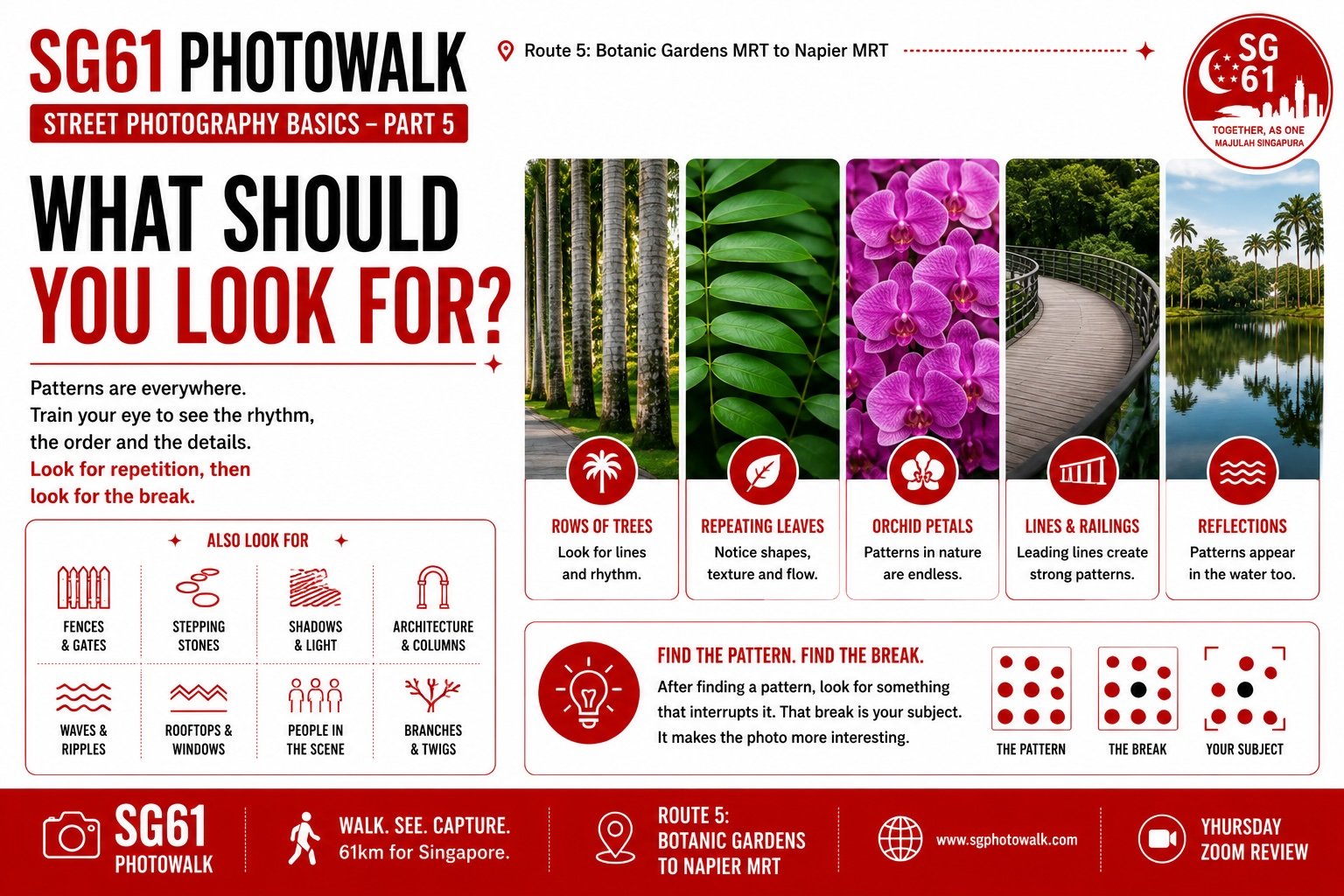
Patterns and repetition.
Negative space and simplicity.
Both teach the same lesson.
A strong photograph does not always need more things in the frame.
Sometimes it needs fewer.
1. Patterns and repetition
Nature repeats itself everywhere.
Leaves.
Tree trunks.
Flowers.
Branches.
Palm trees.
Even the curves of a pathway can create rhythm.
Our eyes naturally enjoy repetition because it gives a photograph order.
Once you begin looking for patterns instead of individual subjects, the garden starts to look completely different.
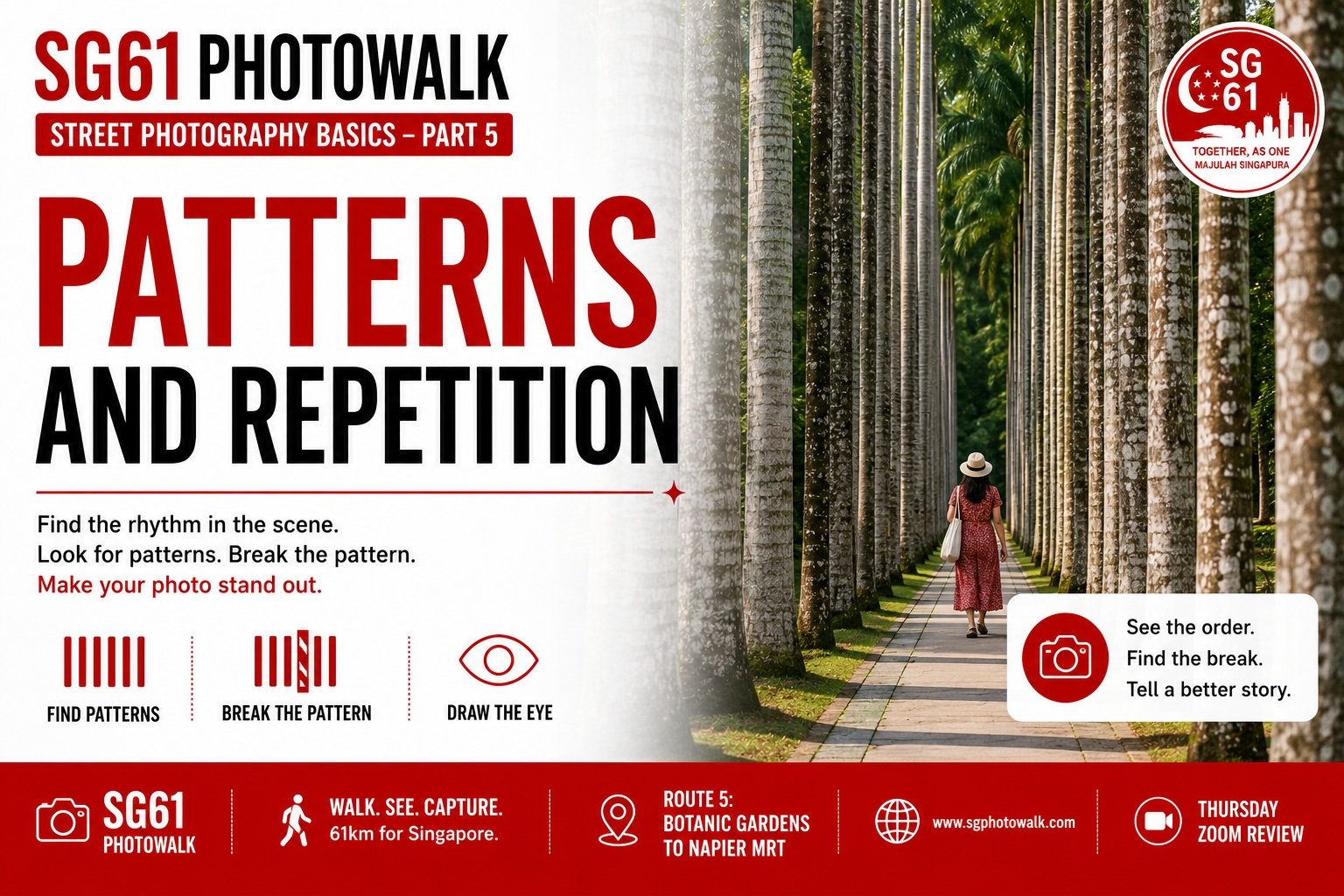
What should you look for?
During the walk, keep an eye out for:
- repeating leaves
- rows of trees
- palm trunks
- orchid petals
- repeating shadows
- fences and railings
- stepping stones
- reflections repeating shapes in the water
- people walking through repeated architectural or natural elements
The Learning Forest and Palm Valley should give us plenty of opportunities.
But do not stop at simply finding a pattern.
The photograph becomes more interesting when something interrupts it.
Break the pattern
Imagine ten green leaves arranged neatly together.
That can make a pleasant photograph.
Now imagine nine green leaves and one yellow leaf.
Immediately your eye goes somewhere.
The same thing happens when a person walks between repeating tree trunks.
Or one flower faces a different direction.
Or a cyclist crosses a repeating row of shadows.
The pattern creates order.
The interruption creates the subject.
That little break is often what makes the photograph memorable.
Try changing your viewpoint
Patterns are very sensitive to camera position.
Move one metre and the shapes may suddenly line up.
Get lower and a row of trees becomes stronger.
Look straight down and leaves may form a completely different composition.
Do not just photograph the first pattern you notice.
Move around it.
Sometimes the photograph is only a few steps away.
Where to practise patterns on Walk 5
Learning Forest
Look for repeating leaves, tree trunks, boardwalk lines and layers of greenery.
Try using one person as a small break in the pattern.
Palm Valley
Rows of palms can create strong visual rhythm.
Instead of photographing the entire landscape, try isolating a smaller section.
National Orchid Garden
This is an obvious place to photograph flowers.
The challenge is not to photograph just one pretty orchid.
Look for repetition.
Similar shapes.
Similar colours.
And then look for one flower that breaks the pattern.
2. Negative space and simplicity
After looking for patterns, we are going to do almost the opposite.
Instead of filling the frame, we are going to leave parts of it empty.
This empty area is called negative space.
It could be sky.
Water.
Grass.
A plain wall.
A dark background.
Or simply an uncluttered area surrounding your subject.
Negative space gives your subject room to breathe.
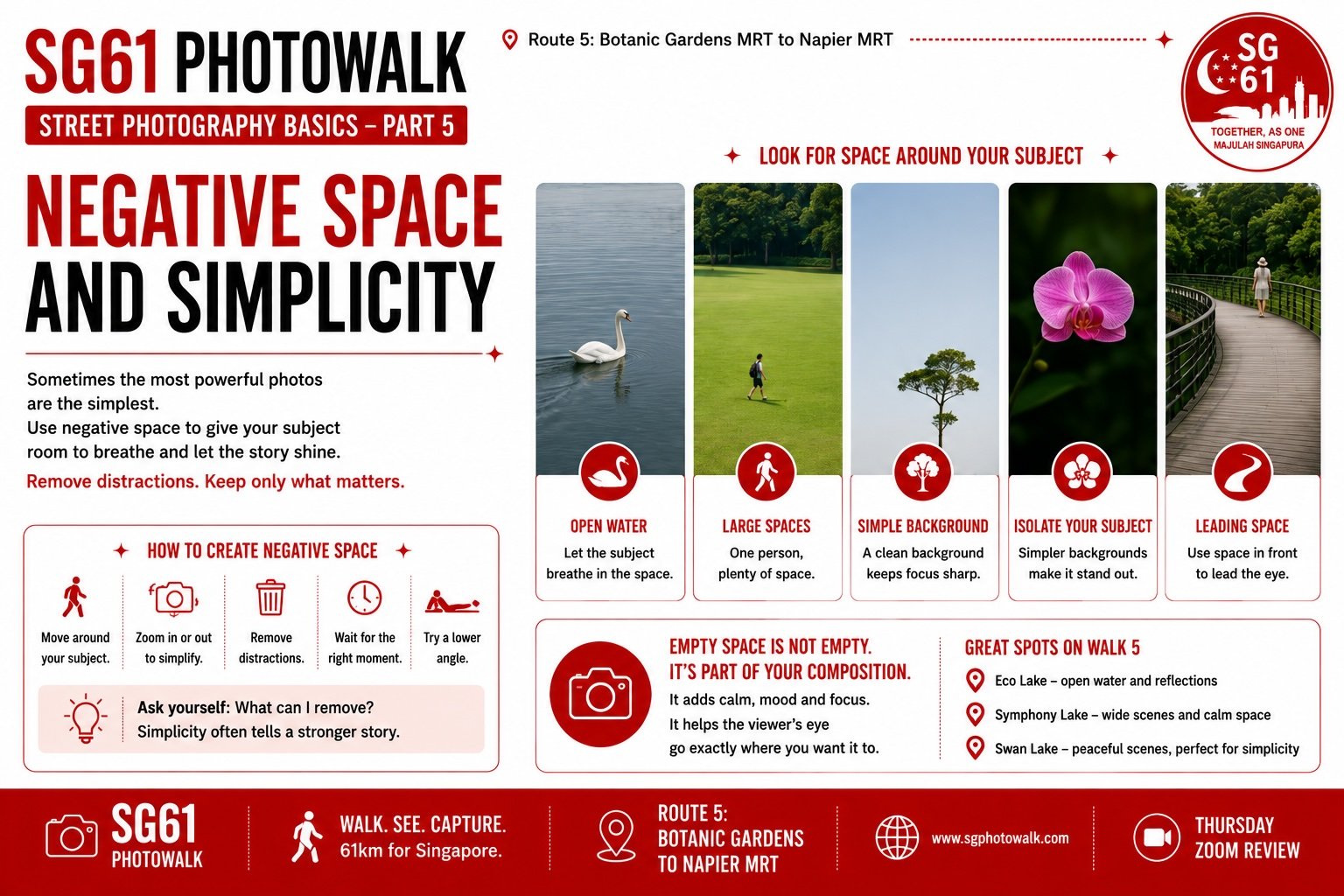
Why simple photographs often feel stronger
When too many things compete for attention, the viewer does not know where to look.
A simpler photograph makes that decision easier.
Imagine one person walking across a huge green lawn.
Or one swan surrounded by calm water.
Or one tree against an open sky.
There may be very little happening in the frame.
But your eye knows exactly where to go.
That is the power of simplicity.
Ask one question before pressing the shutter
When your composition feels messy, ask yourself:
What can I remove?
Maybe you can move slightly to hide a rubbish bin.
Perhaps you can wait until another person leaves the frame.
Maybe zoom in.
Or step backwards and give your subject more space.
Photography is often taught as deciding what to include.
It is just as important to decide what not to include.
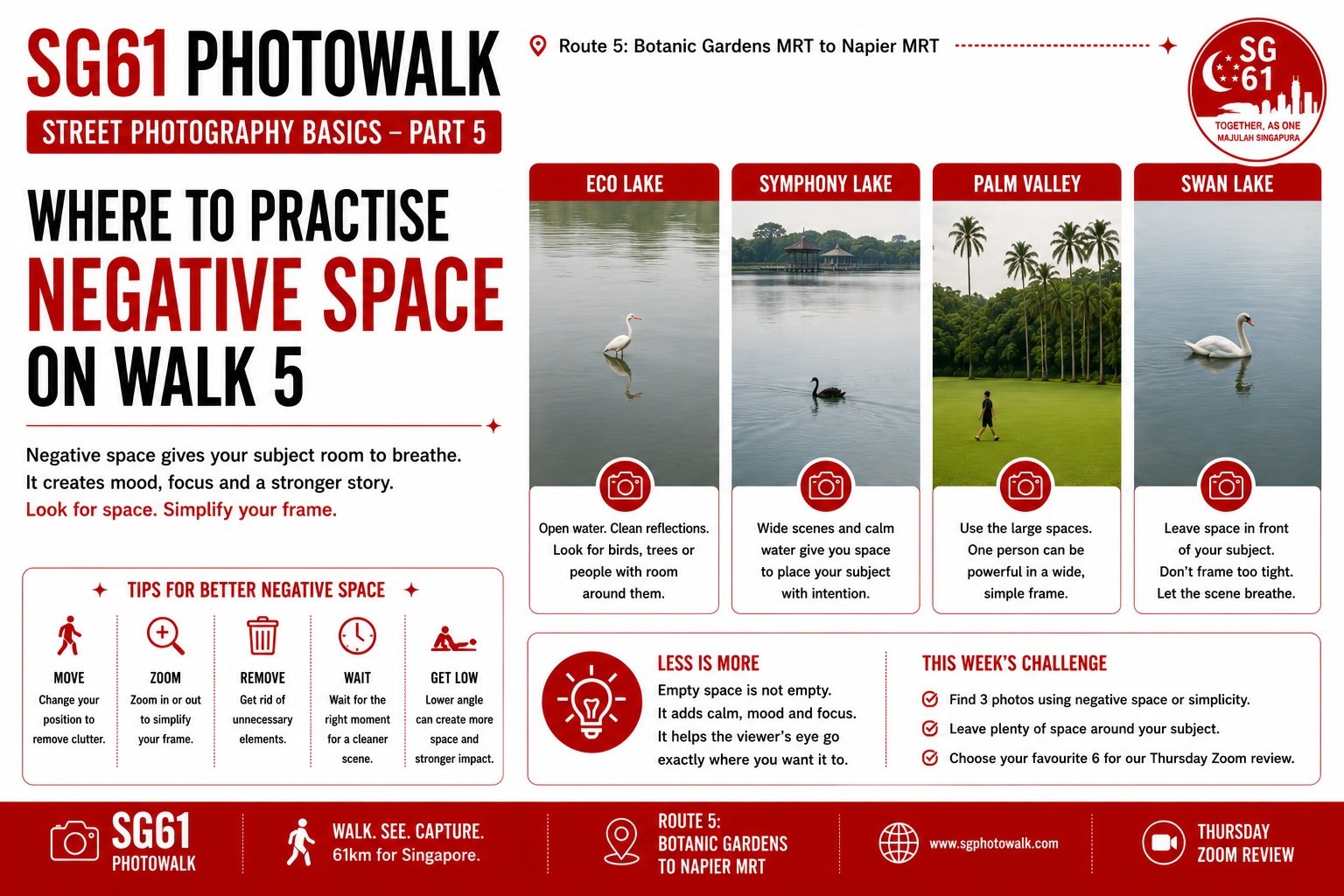
Where to practise negative space on Walk 5
Eco Lake
Water gives you natural empty space.
Look for a bird, reflection, tree or person surrounded by open water.
Symphony Lake
The large areas of water and greenery give you room to simplify your composition.
Try placing a small subject against a much larger landscape.
Palm Valley
One person crossing the lawn can be enough.
You do not need five people, three trees and a building competing for attention.
Swan Lake
This should be a lovely place to practise.
Instead of zooming tightly onto a swan, try leaving plenty of water around it.
The empty space becomes part of the photograph.
Do not be afraid of a quiet frame
Beginners sometimes worry that an image looks empty.
But empty and boring are not the same thing.
A quiet photograph can have mood.
It can feel peaceful.
It can make the viewer pause.
The important question is whether the empty space supports your subject.
If it does, leave it alone.
Do not fill the frame simply because you can.
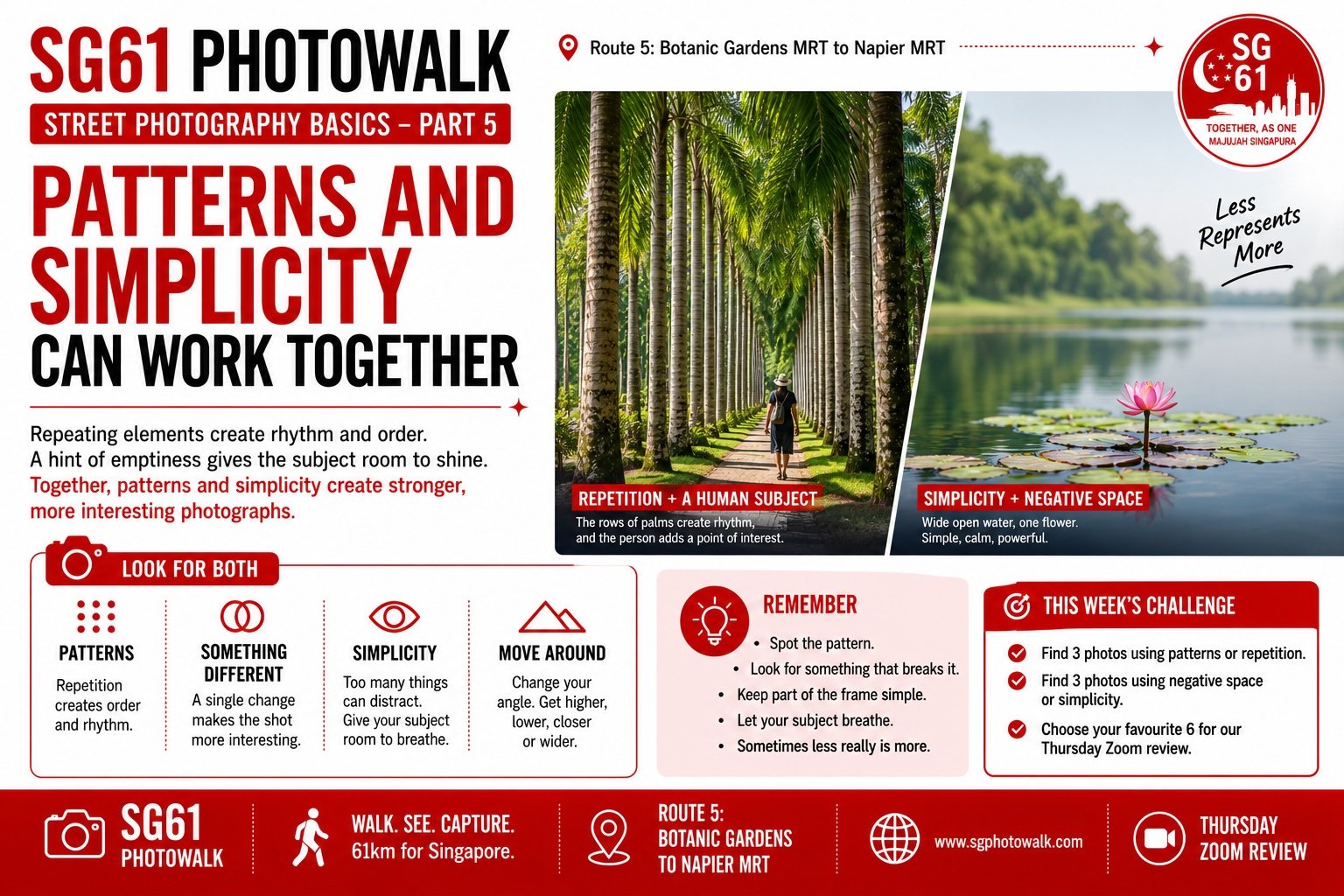
Patterns and simplicity can work together
These two techniques may sound very different, but they can work beautifully together.
Imagine a line of palm trees repeating across the frame.
One person walks underneath them.
Nothing else.
You have repetition.
You have a break in the pattern.
And you have simplicity.
Or imagine one swan surrounded by repeating reflections on the lake.
Again, both techniques are working together.
That is when composition becomes much more interesting.
This week’s SG61 challenge
For Walk 5, try to create:
- Three photographs using patterns or repetition
- Three photographs using negative space or simplicity
For at least one pattern photograph, find something that breaks the repetition.
For at least one simple photograph, leave much more empty space than you normally would.
Then choose your favourite six images for our Thursday Zoom review.
Photograph less, notice more
The Botanic Gardens is full of obvious subjects.
Flowers.
Trees.
Lakes.
Orchids.
But this Wednesday, try not to photograph them simply because they are beautiful.
Look for order.
Look for repetition.
Look for space.
Then simplify.
You may discover that the strongest photograph from the walk contains surprisingly little.
And that is exactly the point.
Walk slowly.
Look carefully.
Photograph less.
See more.