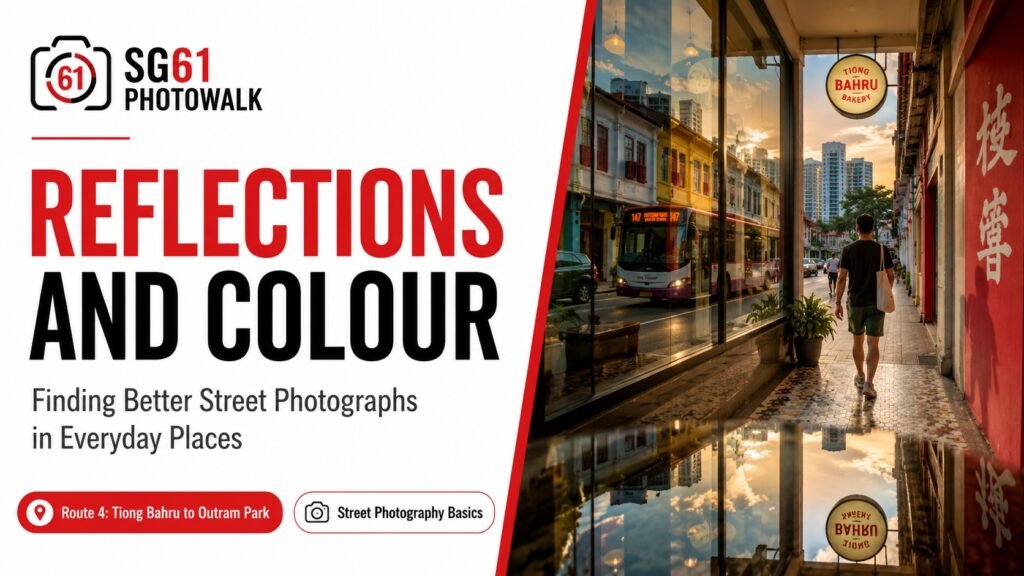
Some of the best street photographs appear when you stop looking directly at the subject.
A shop window catches a passing face.
A puddle turns a normal street upside down.
A red shirt moves across a pale wall and suddenly the whole scene comes alive.
This Wednesday, our SG61 Photowalk takes us from Tiong Bahru MRT to Outram Park MRT.
For this walk, we’ll focus on two simple techniques.
Reflections.
Colour.
Both are easy to understand, but they can completely change the way you see an ordinary street.
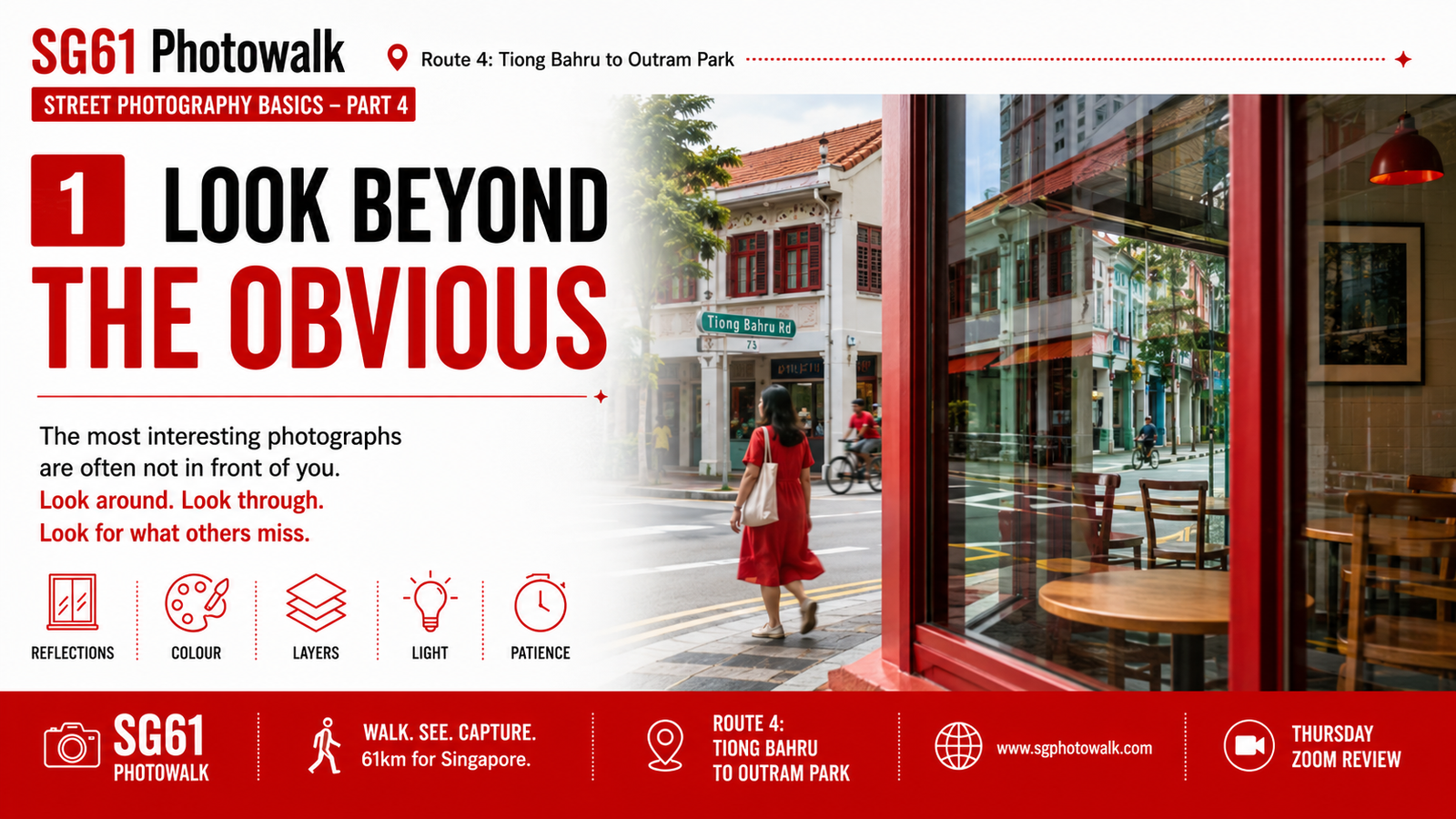
Look beyond the obvious
When we arrive at an interesting place, most of us point our cameras at the main subject.
That’s natural.
But street photography becomes more interesting when you notice what is happening around the subject.
The glass beside it.
The colour behind it.
The shadow below it.
The person about to walk into the frame.
That’s where reflections and colour become useful.
What are reflections?
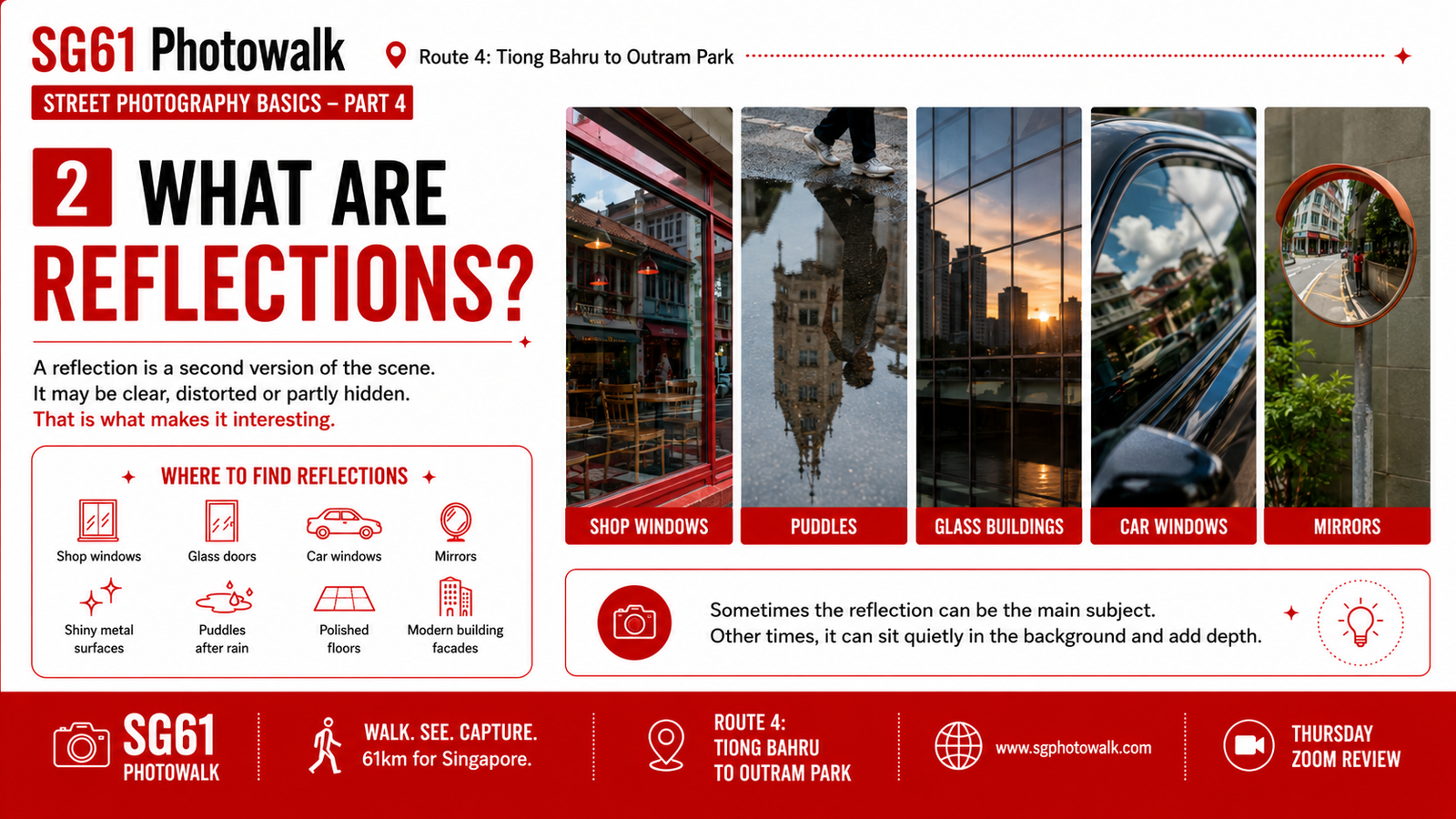
A reflection is a second version of the scene.
It may be clear, distorted or partly hidden.
That is what makes it interesting.
Instead of simply recording what is in front of you, a reflection can add mystery, symmetry and another layer to the photograph.
Look for reflections in:
- Shop windows
- Glass doors
- Car windows
- Mirrors
- Shiny metal surfaces
- Puddles after rain
- Polished floors
- Modern building facades
Sometimes the reflection should be the main subject.
Other times, it can sit quietly in the background and add depth.
Where to find reflections during Walk 4
Tiong Bahru has a lovely mix of old and new.
You’ll find traditional flats, cafés, shopfronts and newer glass surfaces sitting close together.
Look through café windows rather than photographing only from outside.
Watch how people appear in glass doors as they pass.
Look down after rain.
Even a small puddle can reflect buildings, signs or someone walking past.
As we move towards Outram Park, the streets become busier and the buildings change. This gives us more chances to combine reflections with people, traffic and modern architecture.
Move before you shoot
Reflections change when you move.
A small step to the left may bring a person into the reflection.
A lower angle may include more of the building.
A higher angle may remove unwanted distractions.
Don’t take one photograph and walk away.
Move slowly.
Watch the reflection change.
Then wait for the right moment.
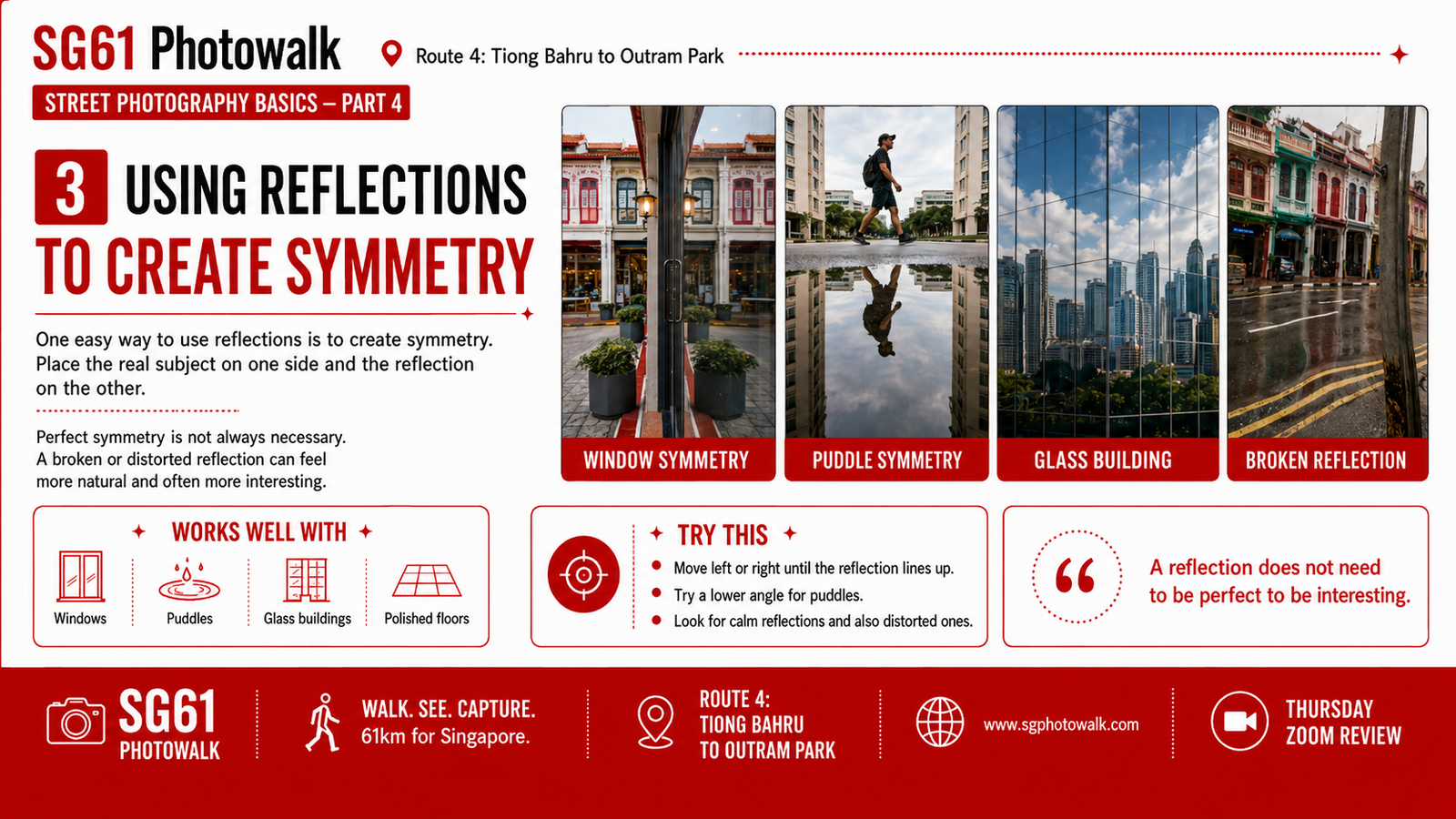
Using reflections to create symmetry
One of the easiest ways to use a reflection is to create symmetry.
Place the real subject on one side and its reflection on the other.
This works especially well with:
- Windows
- Puddles
- Glass buildings
- Polished floors
The result can feel calm and balanced.
But perfect symmetry isn’t always necessary.
A broken or distorted reflection can feel more natural and often more interesting.
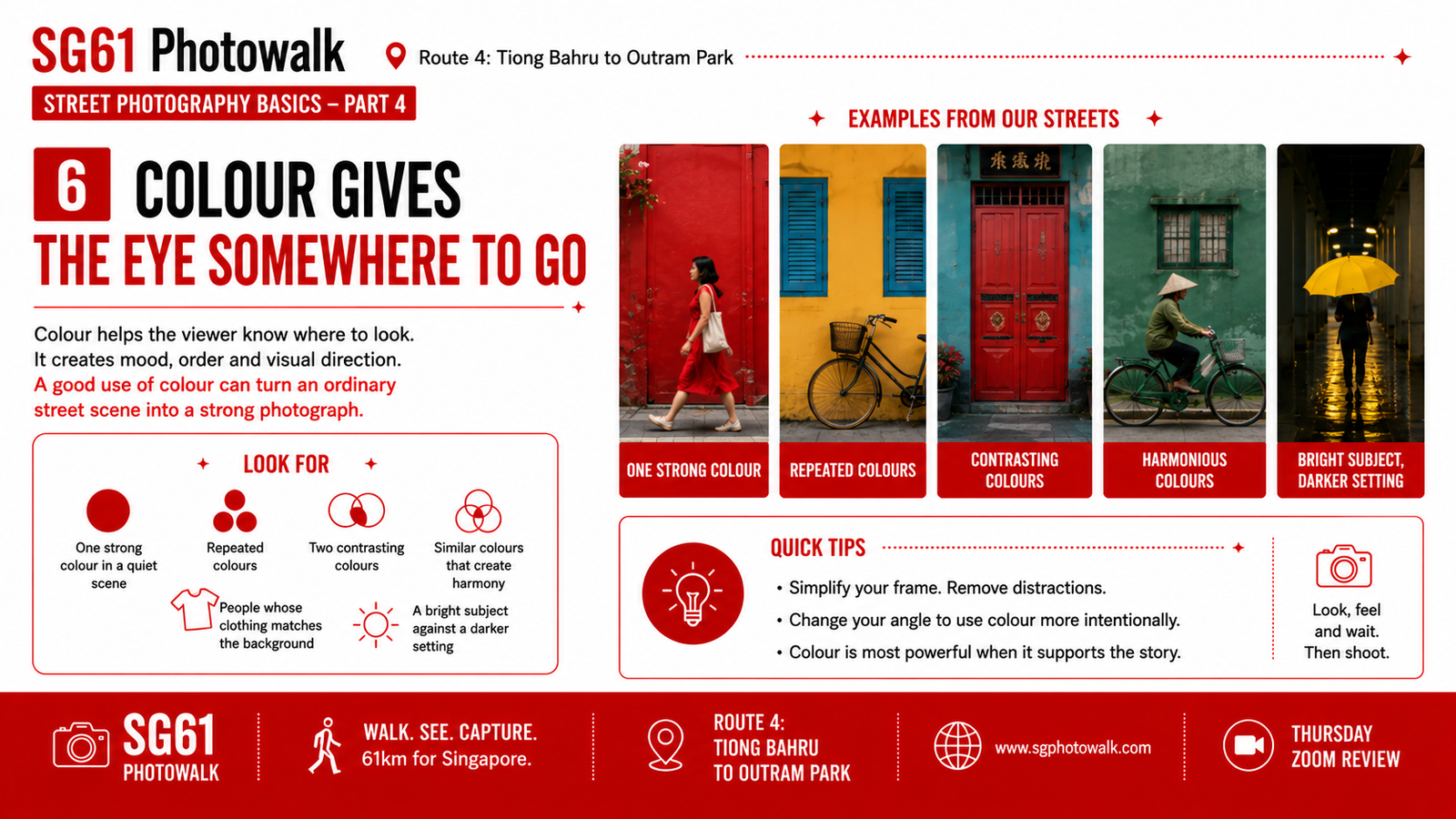
Colour gives the eye somewhere to go
Colour can help your viewer understand where to look.
A bright red shirt in a quiet scene immediately attracts attention.
A yellow sign against a blue wall creates contrast.
Several similar colours across the frame can hold the photograph together.
Colour isn’t just decoration.
It helps create mood, order and visual direction.
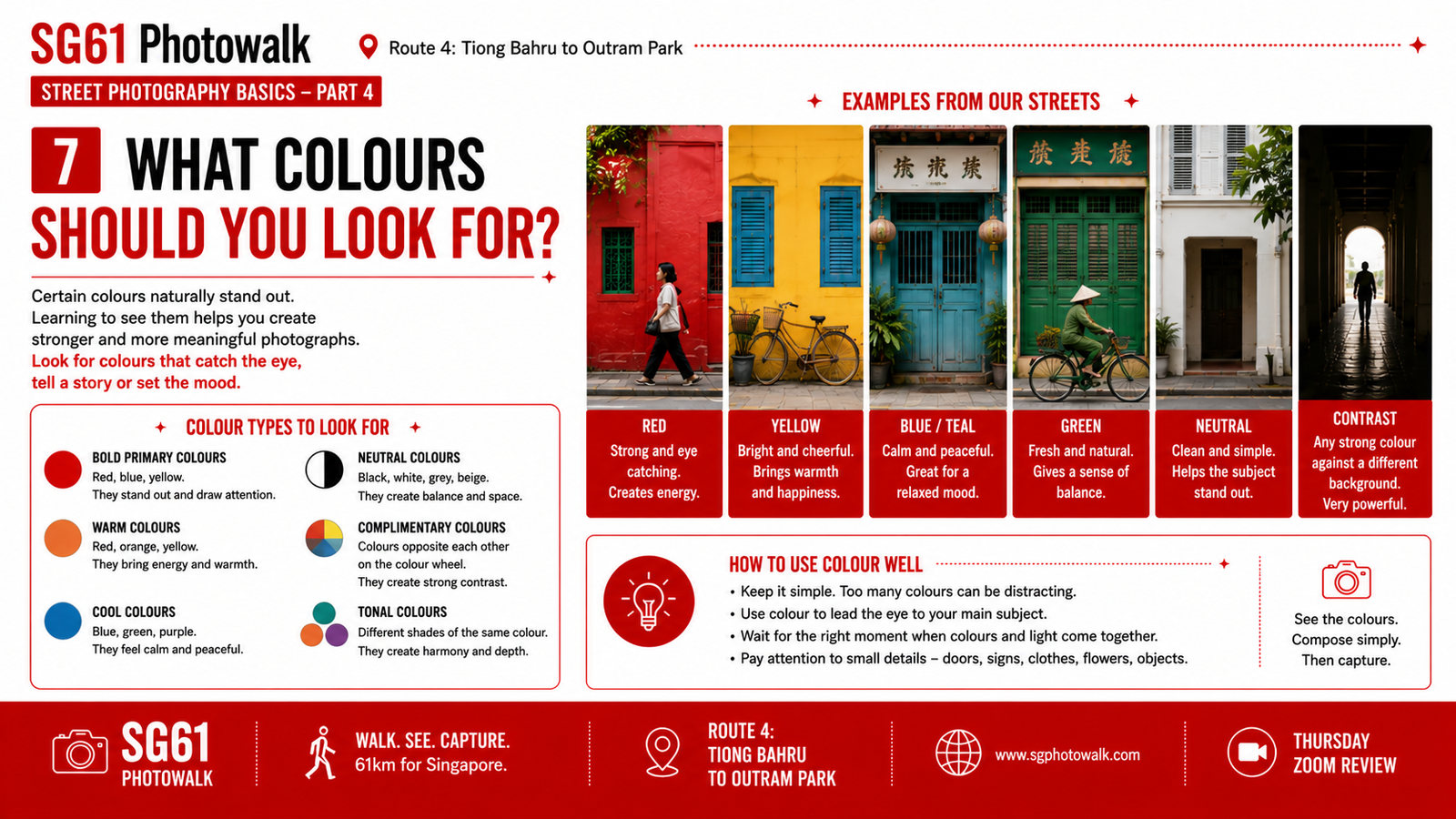
What colours should you look for?
You don’t need to understand complicated colour theory.
Start with something simple.
Look for:
- One strong colour in a quiet scene
- Repeated colours
- Two colours that contrast
- Similar colours that create harmony
- A person whose clothing matches the background
- A bright subject against a darker setting
Once you notice one colour, start scanning the rest of the frame.
Does the colour appear anywhere else?
Can you use it to connect different parts of the photograph?
Finding colour around Tiong Bahru
Tiong Bahru is perfect for this exercise.
Look for colourful doors, signs, walls, plants, bicycles, clothing and food stalls.
The older buildings often have soft, simple tones. This makes a bright colour stand out even more.
Instead of photographing every colourful object, wait for the colour to become part of a story.
A person in red walking past a red sign.
A cyclist against a green wall.
A yellow umbrella appearing in a grey street.
These small connections can make the image feel intentional.
Try using only one main colour
Busy street scenes often contain too many colours.
That can make the photograph confusing.
One simple solution is to choose one main colour before you shoot.
Find a red wall.
Wait for someone wearing red, black or white to enter the frame.
Find a blue shopfront.
Look for another blue object nearby.
This gives the photograph a clear visual idea.
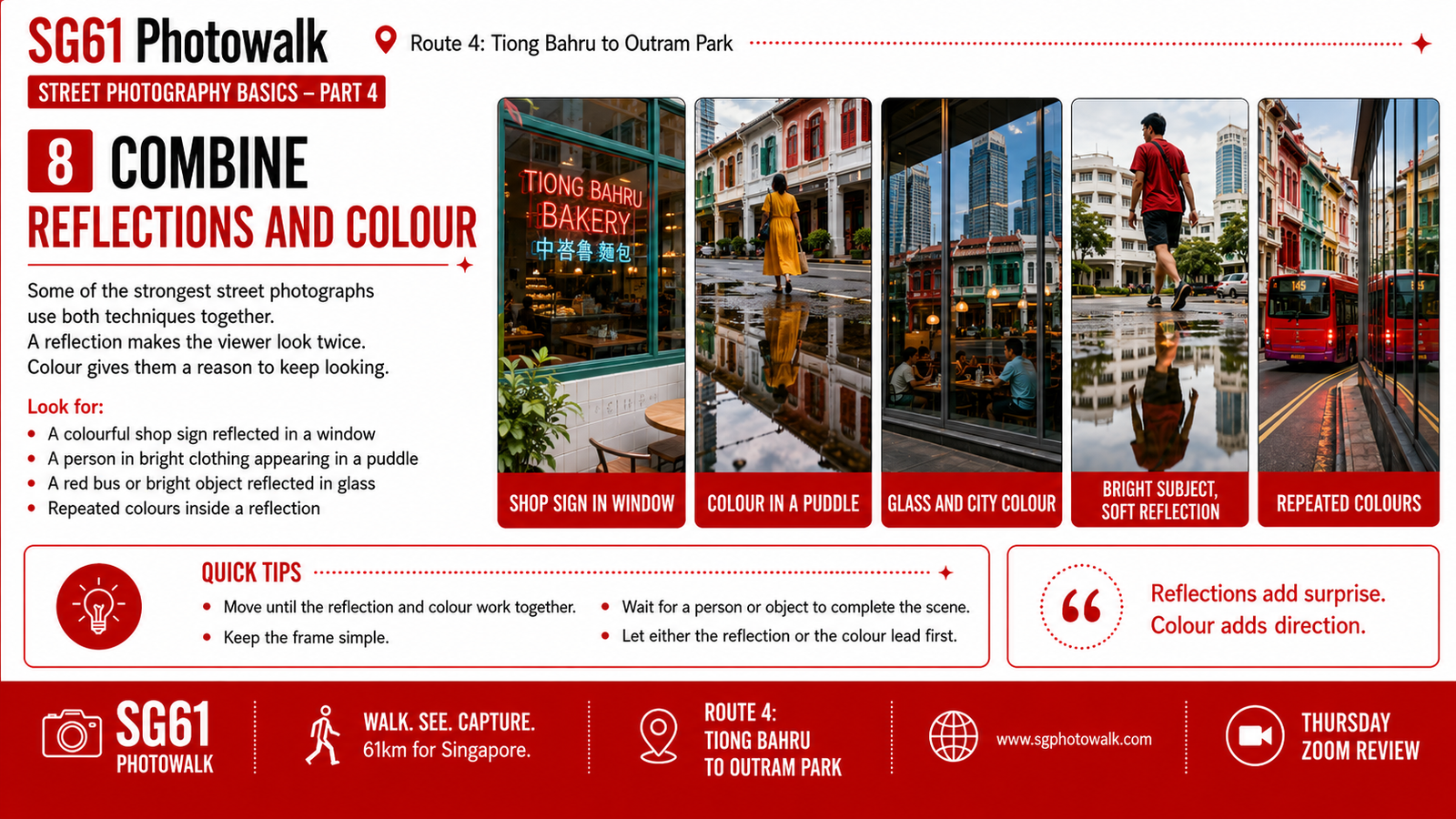
Combine reflections and colour
The strongest photographs may use both techniques together.
A colourful shop sign reflected in a window.
A person in bright clothing appearing inside a puddle.
A red bus passing across a glass building.
A reflection already makes the viewer look twice.
Colour gives them a reason to keep looking.
Common mistakes
The first mistake is photographing every reflection you see.
A reflection still needs a subject.
Ask yourself what the viewer should look at first.
The second mistake is including too many colours.
Try simplifying the frame.
Move closer or change your angle.
The third mistake is forgetting the background.
A good reflection can easily be ruined by clutter behind it.
Slow down and check the whole frame before pressing the shutter.
A simple challenge for Walk 4
During this Wednesday’s SG61 Photowalk, try to create:
- Three photographs using reflections
- Three photographs where colour becomes the main idea
For the reflection photographs, try different surfaces and angles.
For the colour photographs, look for repetition, contrast or one strong colour in a simple scene.
Choose your favourite six images after the walk.
We’ll discuss them during Thursday’s Zoom review.
Photography is learning to notice connections
A reflection connects two scenes.
Colour connects different parts of the frame.
That is what makes these techniques so useful.
They help us move beyond simply photographing what is there.
They help us organise the street and create something with more feeling.
This Wednesday, walk slowly.
Look through windows.
Look down at the ground.
Notice what people are wearing.
Watch how colour moves through the street.
You may find that the most interesting photograph isn’t directly in front of you.
It may be beside you, below you, or quietly reflected in a piece of glass.